

This guide was developed by the curatorial team at Dolphin Galleries, a fine-art gallery with direct representation of limited-edition bronze sculpture. The pricing data below reflects real foundry invoices, artist studio rates, and live auction records reviewed in 2024–2026.
Quick Answer: Bronze Sculpture Price Ranges at a Glance
No two bronze sculptures are priced the same way, which is exactly why a buyer searching for "how much does a bronze statue cost" gets wildly different numbers — $2,500 on one site, $75,000 on another, for what sounds like the same life-size figure. Both numbers can be correct. The gap exists because of casting method, artist reputation, edition size, foundry location, and finishing quality. This guide unpacks every variable.
Master Price Table — Size × Source Type (2024–2026)
| Size Tier | Chinese Factory Direct | US/EU Independent Studio | Gallery/Known Artist |
|---|---|---|---|
| Tabletop / Small (under 18") | $300 – $1,500 | $800 – $5,000 | $500 – $12,500+ |
| Medium (2–4 ft) | $1,500 – $6,000 | $5,000 – $18,000 | $3,000 – $40,000 |
| Life-Size (5–6 ft) | $4,000 – $12,000 | $18,000 – $50,000 | $25,000 – $120,000 |
| Monumental (8 ft+) | $10,000 – $35,000 | $40,000 – $150,000 | $80,000 – $500,000+ |
These figures assume lost-wax (hot-cast) foundry bronze. Cold-cast bronze resin — discussed fully below — starts around $50 and tops out near $2,000 regardless of size. They are fundamentally different products.
Why can two 6-foot statues differ by $50,000? Consider a life-size human figure cast from a Chinese factory at $8,000 vs. a life-size figure by a gallery-represented sculptor at $58,000. The factory piece may use a sand-cast mold (faster, cheaper, lower detail fidelity), a thinner wall (5–6 mm vs. 8–10 mm), a commercial alloy with variable tin content, a cold-applied chemical patina, and it carries zero secondary-market provenance. The gallery piece uses a lost-wax investment casting, a certified 85:5:5:5 silicon bronze alloy, a hot-applied patina built up in multiple layers by the artist, and comes with a numbered certificate of authenticity that underpins its resale value. You are not buying the same object.
Cold-Cast Bronze Resin vs. Hot-Cast Foundry Bronze: A Side-by-Side Comparison
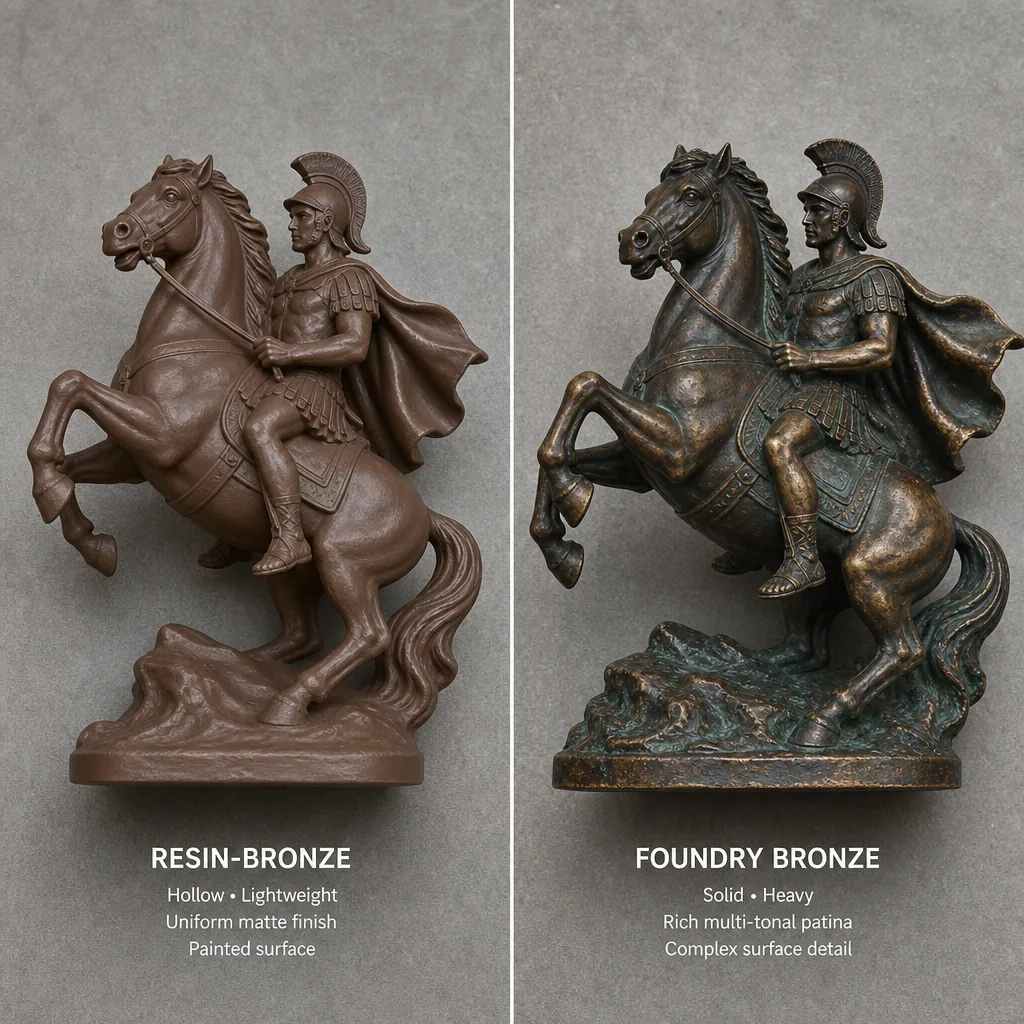
This is the single most important distinction any bronze buyer must understand before evaluating prices.
| Factor | Cold-Cast Bronze Resin | Hot-Cast Foundry Bronze |
|---|---|---|
| What it is | Polyester resin mixed with bronze powder (~20–30% metal content) | Pure bronze alloy cast molten in a foundry (85–95% copper/tin) |
| Typical price range | $50 – $2,000 | $300 – $500,000+ |
| Weight (life-size figure) | 15–40 lbs | 150–400 lbs |
| Detail fidelity | Good for surface texture | Excellent — captures fingerprints, tool marks |
| Lifespan | 20–50 years (UV degradation, brittleness) | 500+ years (museum-grade pieces last millennia) |
| Patina | Painted or cold-applied; can chip | Chemical or heat-applied; bonds to metal surface |
| Resale / investment value | Near zero — no secondary market exists | Meaningful — auction markets, provenance-based appreciation |
| Certificate of authenticity | Rarely issued | Standard for limited editions |
| Indoor/outdoor suitability | Indoor only (UV and freeze damage) | Indoor and outdoor rated |
| Recognizable feel | Hollow knock, light weight, slightly warm to touch | Solid ring, heavy, cold to touch |
Bottom line: Cold-cast bronze resin is a decorative reproduction product. It is not an investment-grade object and should not be evaluated on the same price scale as foundry bronze. When a retailer lists a "life-size bronze lion" for $800, it is almost certainly cold-cast resin, not foundry bronze.
💡 Quick test: Lift the piece. A genuine foundry-cast tabletop sculpture 6–8 inches tall typically weighs 3–8 lbs. A cold-cast piece of the same size weighs under 2 lbs. The weight difference is unmistakable.
The Lost-Wax Process: A Transparent Line-Item Cost Model
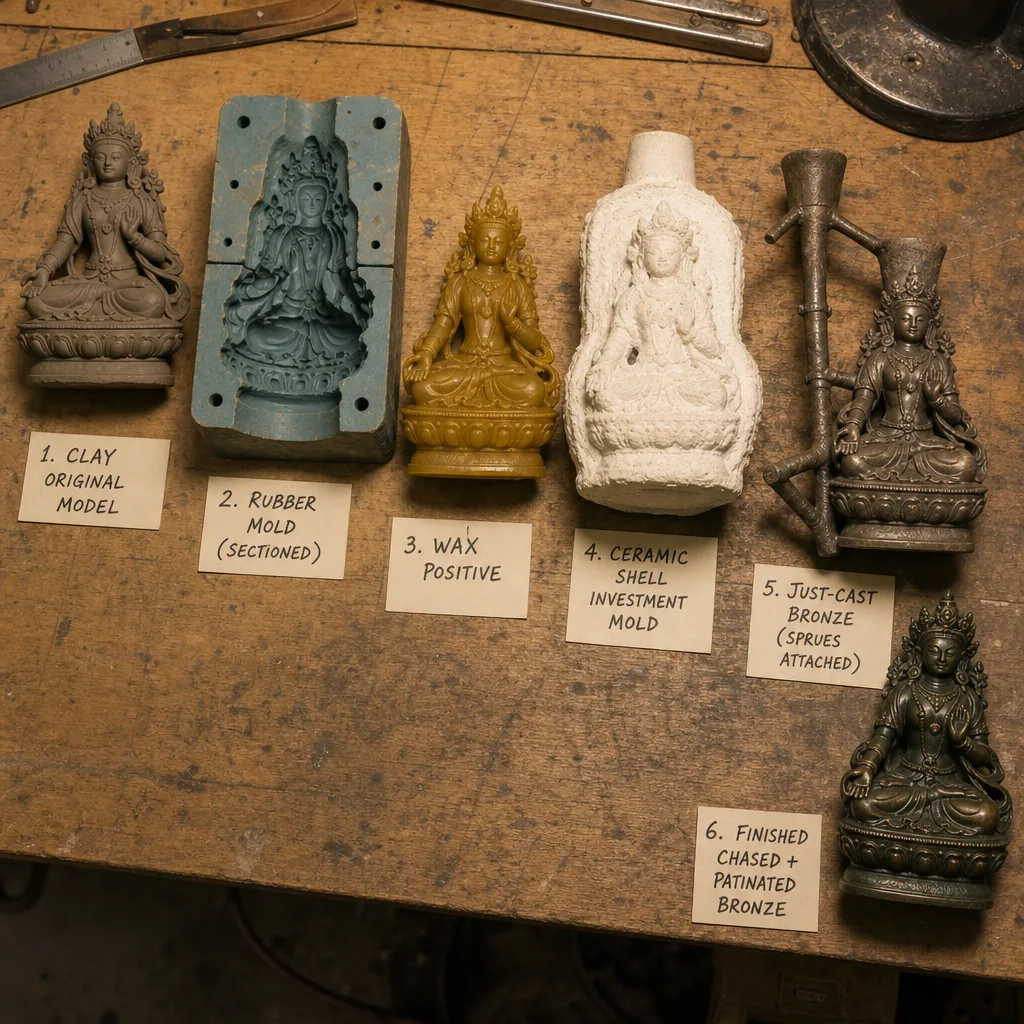
Understanding where the money goes is the fastest way to evaluate whether a quote is reasonable or suspicious. The lost-wax (cire perdue) process has remained essentially unchanged for 5,000 years. Here is every cost center, with real-world figures:
Step-by-Step Cost Breakdown for a Life-Size Human Figure (approx. 200 lbs finished weight)
| Stage | What Happens | Estimated Cost (US Studio) |
|---|---|---|
| 1. Armature & Clay Original | Steel armature fabricated; artist builds clay or wax model | $2,000 – $8,000 (artist time, 40–200 hrs at $40–$80/hr) |
| 2. Rubber Mold | Foundry technician applies silicone or urethane rubber over original | $800 – $2,500 |
| 3. Mother Mold (Mother Shell) | Rigid fiberglass or plaster jacket to support the rubber | $400 – $1,000 |
| 4. Wax Casting | Molten wax injected or poured into mold; wax copies assembled | $600 – $1,500 per edition casting |
| 5. Ceramic Shell / Investment | Wax positive dipped 8–12 times in silica slurry; dried between coats | $1,200 – $3,000 |
| 6. Burnout (Dewax) | Ceramic shell fired at 1,600°F; wax melts out | $200 – $500 |
| 7. Bronze Pour | Molten bronze (~1,850°F) poured into shell | $2,500 – $6,000 (material + furnace time) |
| 8. Shell Removal & Chasing | Ceramic broken away; bronze seams and sprues hand-chased/welded | $1,500 – $4,000 |
| 9. Patina Application | Heat + chemical patina applied; waxed to seal | $500 – $2,000 |
| 10. Base Fabrication | Stone, steel, or wood base cut and fitted | $200 – $1,500 |
| 11. Foundry Overhead & Markup | Equipment amortization, energy, insurance | $1,500 – $4,000 |
| Total (first casting) | $11,400 – $34,000 | |
| Subsequent edition castings | Mold already exists; material + labor only | $6,000 – $18,000 per cast |
This cost model explains why a legitimate US studio quoting $18,000–$25,000 for a life-size commission is not overcharging — and why a Chinese factory quoting $4,000 for the same size must be cutting corners somewhere in the above chain.
Raw Material Cost Math: Setting the Price Floor
Bronze is a commodity. Its price moves daily on the London Metal Exchange (LME) alongside copper, which makes up roughly 85% of most silicon bronze alloys (C87200 or C87500 are the most common casting grades).
Current benchmark (2024–2025): - LME copper spot: approximately $4.00–$4.50/lb - Silicon bronze alloy (ingot form): approximately $3.00–$4.00/lb at foundry purchase - Useful rule of thumb: budget $3.50/lb for raw material alone
Size-to-Weight Reference (lost-wax, 8mm wall thickness):
| Statue Type | Approx. Finished Weight | Raw Material Cost (@ $3.50/lb) |
|---|---|---|
| Small tabletop (6–8 in) | 3–8 lbs | $10 – $28 |
| Medium figure (24–36 in) | 25–60 lbs | $88 – $210 |
| Life-size human (5–6 ft) | 150–250 lbs | $525 – $875 |
| Large animal (life-size horse) | 400–800 lbs | $1,400 – $2,800 |
| Monumental (10–12 ft) | 1,000–3,000 lbs | $3,500 – $10,500 |
What this tells you: Raw material is almost never the dominant cost at the studio level — labor, mold-making, and artistic value dominate. A 200-lb life-size figure carries only ~$700 in raw bronze. If a foundry quotes you $3,000 total for that piece, they are either skipping multiple process steps, using thinner walls (4–5 mm instead of 8–10 mm), or the "bronze" is largely resin. Legitimate material + labor costs make anything below ~$12,000 for a US-made life-size figure almost physically impossible.
On wall thickness: The accepted quality standard for outdoor monumental bronze is 3/8 inch (9.5 mm). Indoor gallery pieces typically run 1/4 inch (6.4 mm). Always ask for the wall thickness specification before purchasing any piece over $5,000.
Edition Size Economics: How Scarcity Drives Both Price and Investment Value
Small Edition, Maximum Impact: See Edition-Size Pricing in Action
These Dolphin Galleries bronzes illustrate exactly how edition size and scale shape price — from an ultra-limited edition of 15 pieces to accessible editions of 250, all genuine lost-wax foundry bronzes by Chris Barela.


Edition size is one of the most misunderstood pricing variables. Here is how it works mathematically and from an investment perspective.
When a sculptor creates a limited edition:
- The foundry mold cost (~$3,000–$15,000 for a medium piece) is amortized across all castings
- A 1/1 unique casting bears the full mold cost — plus the prestige premium of "only one exists"
- A 1/9 limited edition spreads mold cost across 9 castings — each unit is cheaper to produce but carries strong scarcity value
- A 1/25 edition further reduces per-unit mold cost but begins to dilute collectibility
- An open edition (no size cap) has near-zero mold amortization per unit but virtually no secondary-market investment value
Edition Size vs. Price and Investment Value:
| Edition Size | Typical Price Multiplier vs. Open Edition | Secondary Market Potential |
|---|---|---|
| 1/1 (unique) | 10x – 50x | Very high — single-object scarcity |
| 1/5 to 1/9 | 4x – 12x | High — collector-grade |
| 1/10 to 1/25 | 2x – 6x | Moderate — depends on artist trajectory |
| 1/26 to 1/100 | 1.5x – 3x | Low to moderate |
| 1/101 to 1/500 | 1x – 1.5x | Primarily decorative; modest appreciation |
| Open edition | Baseline | Minimal secondary market |
Real example from our catalog: Chris Barela's Cast Your Fate to the Wind is a limited edition of only 15 pieces, priced at $12,500. With 15 castings total, once the edition sells out, no new ones can legally be produced — the molds are retired. Contrast that with Bermuda, a marine bronze in an edition of 500 at $1,020. Both are authentic foundry bronzes by the same artist. The smaller edition commands a fundamentally different investment profile.
💡 The "Artist's Proof" rule: Most editions include 10–15% artist's proofs (APs) beyond the stated number. A 1/9 edition may actually have 9 + 1AP = 10 pieces in existence. Always ask the total production count including APs.
Patina Types: How Finishing Affects Price and Long-Term Value
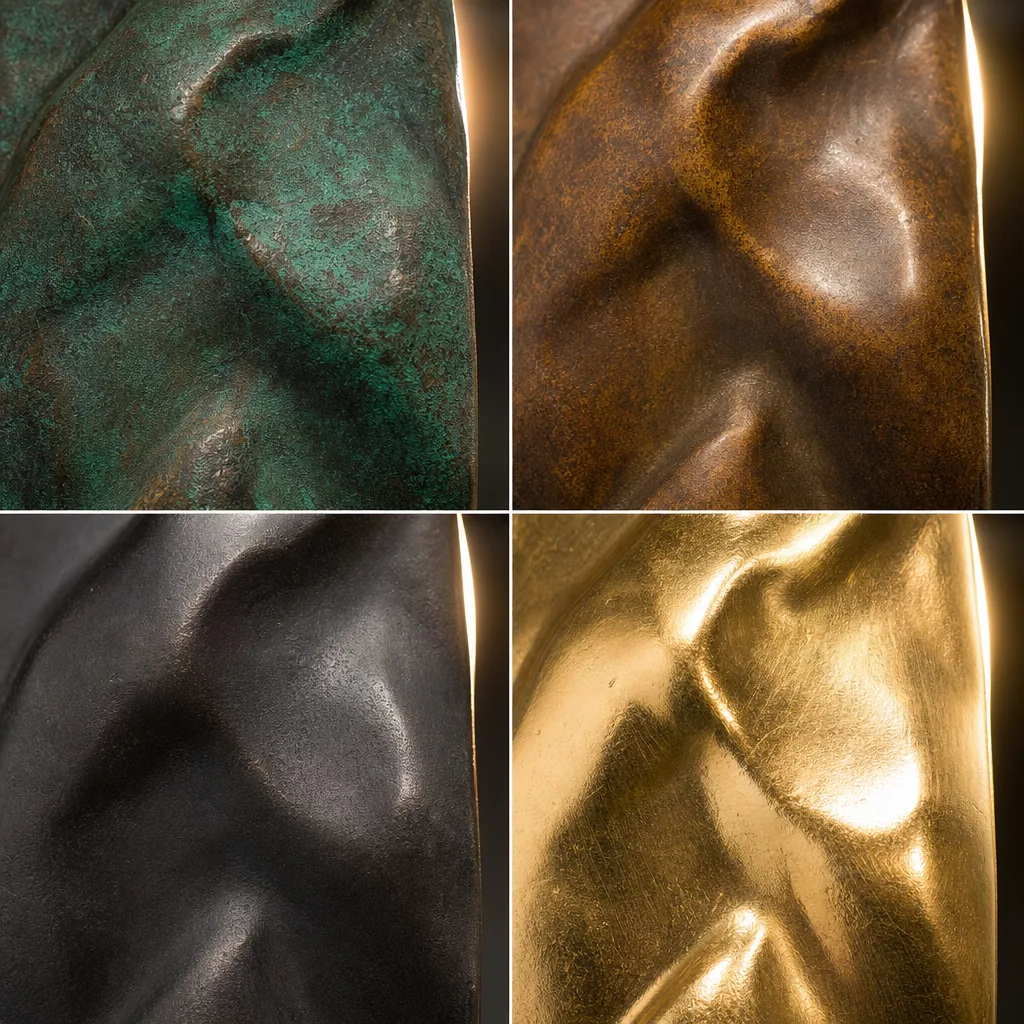
Patina is not just cosmetic — it is a chemical bond with the metal surface that protects the bronze and defines the sculpture's visual identity. The type of patina applied affects the price you pay at purchase and the maintenance cost you carry over the life of the piece.
Common Patina Types and Their Cost Implications:
| Patina Type | Application Method | Visual Result | Added Cost to Piece | Longevity | Maintenance Interval |
|---|---|---|---|---|---|
| Verde antique (natural) | Years of outdoor oxidation | Green patina | $0 | Permanent if allowed | Annual waxing |
| Brown/liver of sulfur | Chemical, cold-applied | Mid-brown tones | $100 – $300 | 5–10 years before re-patination | Every 3–5 years |
| Black/gun metal | Chemical, hot-applied | Dark graphite-black | $300 – $800 | 10–20 years | Every 5–8 years |
| Multi-color hot patina | Layered heat + chemicals, hot-applied | Gold, amber, green, brown tones | $800 – $2,500 | 15–25 years | Every 8–12 years |
| Polished/lacquered | Mechanical polish + clear lacquer | Bright metallic gold | $400 – $1,200 | Indefinite if lacquer intact | Lacquer recoat every 5–10 yrs |
Why this matters for investment: A hot-applied, multi-layer patina by the original artist (or under the artist's direct supervision) is considered part of the artwork and is documented in the certificate of authenticity. Cold-applied patinas by finishing shops are considered production finishing and carry less provenance weight. When a sculpture comes up for resale or auction, patina condition and type are evaluated by appraisers — a deteriorated or improperly re-patinated surface can reduce value by 20–40%.
Are Bronze Sculptures a Good Investment? Real Data, Real Nuance
This is the question that no competitor answers honestly. Here is the complete picture.
When Bronze Appreciates: The Evidence
Auction comparables (foundry bronze, limited editions):
- Frederic Remington, Bronco Buster (1895 original cast): First cast sold at auction for $16,000 in the 1970s. A comparable authorized cast sold at Christie's for $630,000 in 2023. Annualized appreciation: approximately 12% over 50 years.
- Auguste Rodin, The Thinker (authorized posthumous cast by Musée Rodin): Authorized casts issued in editions of 12 through the official foundry. Museum-authorized casts have traded between $1.2M and $4.9M at auction depending on casting date and provenance.
- Contemporary limited-edition market: Established gallery artists with edition sizes under 25 have shown average appreciation of 8–15% annually over 5–10 year holding periods when tracked through gallery resale and secondary-market platforms like Invaluable and AskArt.
The Conditions That Predict Appreciation
A bronze sculpture is likely to appreciate in value if: 1. Edition size is 25 or fewer — genuine scarcity creates secondary-market pricing pressure 2. The artist has institutional representation — gallery shows, museum acquisitions, public commissions all build provenance trail 3. The piece is documented — numbered certificate of authenticity, foundry stamp, artist signature on the bronze itself 4. Condition is maintained — patina in original or properly restored condition; no repairs to structural bronze 5. The foundry is verifiable — a named, active foundry that can authenticate the casting history
The Honest Risks
- Illiquid market: Bronze sculpture is not a stock. Selling takes months to years unless you consign to an established gallery or auction house.
- Forgeries: Unauthorized posthumous casts of famous sculptors (Remington, Dalí, Barye) are a documented problem. Foundry marks can be faked. Always require a COA traceable to the original artist's estate or their authorized foundry.
- Condition costs: Re-patination of a monumental outdoor piece can run $2,000–$8,000 per session. This is a real cost of ownership that affects net investment return.
- Artist trajectory risk: Contemporary artist bronzes are only as investable as the artist's continued reputation. Emerging artists carry more risk than established names.
Verdict: For collectors buying limited editions (under 25) by gallery-represented artists with documented provenance, bronze sculpture has historically performed comparably to mid-tier art market indices — 6–12% annualized over 10+ year horizons. For decorative open-edition bronzes, investment expectations should be minimal. Buying for joy is always valid; buying for guaranteed return requires the discipline described above.
From Dolphin Galleries: Chris Barela's Cast Your Fate to the Wind — a limited edition of just 15 pieces — exemplifies the investment-grade end of our catalog. With fewer pieces in existence than most blue-chip print editions, and a foundry bronze that will outlast any paper asset, it represents exactly the kind of scarcity that the secondary market rewards.
Regional Price Comparison: US Studio vs. European Foundry vs. Chinese Factory vs. Indian Foundry
Every buyer eventually confronts the question: why does a Chinese foundry quote $5,000 for what a US studio charges $35,000? The answer is not simply "profit margin." Here is an honest breakdown.
| Factor | US / Canadian Studio | European Foundry (Italy, France) | Chinese Factory (Hebei, Shandong) | Indian Foundry (Rajasthan, Tamil Nadu) | Eastern European Studio (Czech, Poland) |
|---|---|---|---|---|---|
| Typical life-size cost | $18,000 – $60,000 | $20,000 – $70,000 | $3,000 – $12,000 | $4,000 – $14,000 | $8,000 – $22,000 |
| Bronze alloy certification | Standard (C87200) | Standard (DIN 1705) | Variable — request certificate | Variable | Usually available |
| Lost-wax quality | High | Very high (ancient tradition) | Moderate to high | Moderate | Moderate to high |
| Wall thickness typical | 8–10 mm | 8–12 mm | 4–7 mm | 5–8 mm | 6–9 mm |
| Patina quality | Artist-supervised | Artisan-applied | Production-level | Production-level | Artisan-applied |
| Shipping to US (life-size) | $300 – $1,500 | $2,000 – $6,000 | $800 – $3,500 (by sea) | $1,000 – $4,000 | $1,500 – $4,500 |
| Lead time | 3–12 months | 4–14 months | 45–120 days | 60–150 days | 3–9 months |
| IP/copyright risk | None | None | Moderate (documented copying) | Low | Low |
| Resale/auction credibility | Highest | Highest | Low | Low | Moderate |
The honest case for and against each:
- US/EU: Highest price, highest quality standard, fullest provenance documentation. Best for investment-grade purchases. Longest lead times are a feature — rushed bronze is bad bronze.
- Chinese factory-direct: Lowest price, fastest turnaround, acceptable decorative quality when specified correctly. Best for large-quantity decorative installations (hotel lobbies, municipal parks) where investment grade is not required. Request alloy composition certificates in writing.
- Indian foundry: Strong tradition of lost-wax casting (Dhokra tradition is thousands of years old). Quality ranges widely. Better for figurative and religious subjects; less established for contemporary studio art.
- Eastern European: Best value for investment-grade quality outside of US/EU pricing. Czech and Polish foundries supply several prominent European sculptors. Less known in US collector circles — lower resale recognition risk.
Shipping, Crating, and Installation: The Hidden Cost of Large Bronze
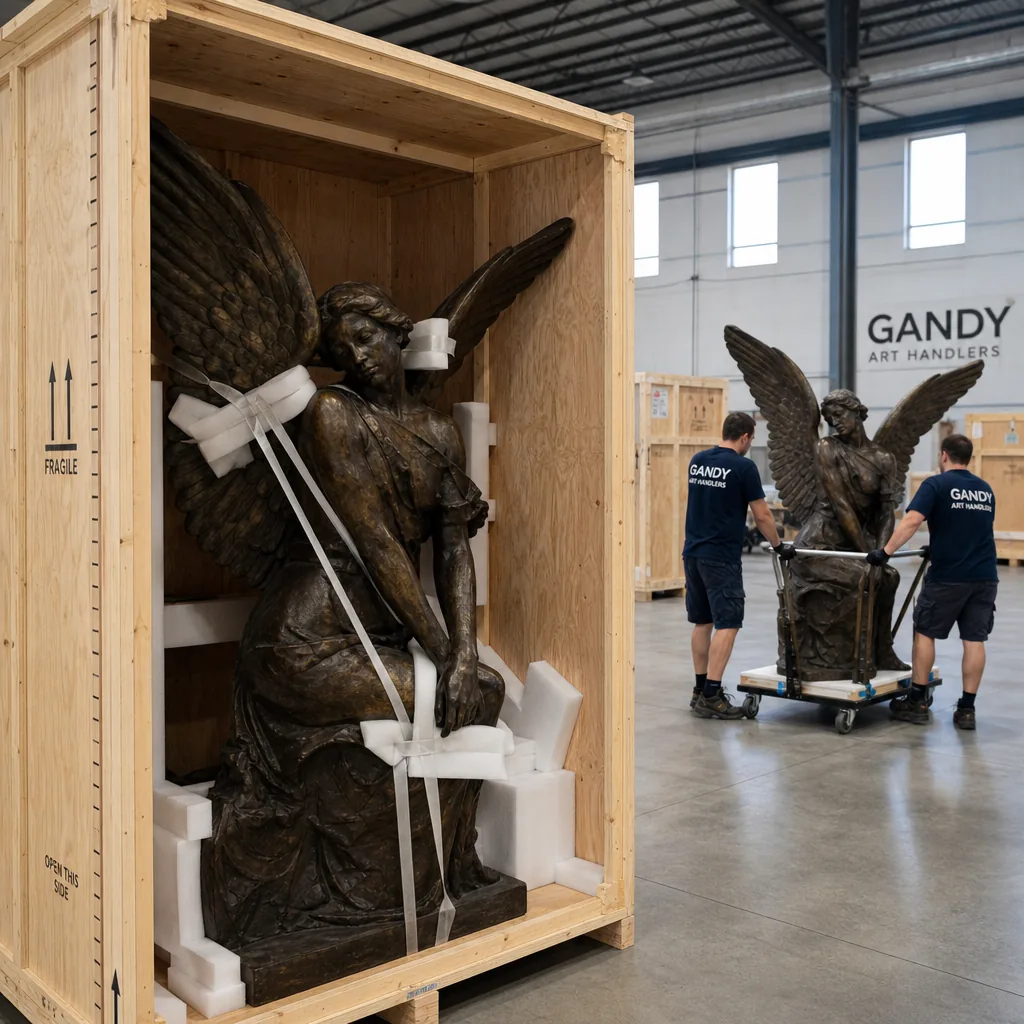
Buyers focused on the sculpture price often overlook the logistics cost, which can add 5–20% to the total for large outdoor pieces.
Cost Estimates by Statue Size:
| Size / Weight | Domestic Crating | Domestic Freight (US) | International Shipping | Crane/Installation |
|---|---|---|---|---|
| Small (under 50 lbs) | $50 – $150 | $80 – $300 | $200 – $600 | Not required |
| Medium (50–200 lbs) | $150 – $400 | $300 – $800 | $600 – $2,000 | $200 – $500 |
| Life-size (200–500 lbs) | $400 – $1,200 | $600 – $2,000 | $1,500 – $5,000 | $500 – $2,500 |
| Monumental (500–3,000 lbs) | $1,000 – $4,000 | $1,500 – $6,000 | $3,000 – $12,000 | $1,500 – $15,000+ |
What drives these costs: - Custom crating is not optional for bronze — vibration and impact during transit crack ceramic-shell repairs and damage patina. Factory-made crates are insufficient for large pieces. - Flatbed freight (required over ~500 lbs) is charged by weight and mile. A 600-lb monumental on a pallet from California to New York runs approximately $1,800–$3,200. - White-glove installation for a life-size garden sculpture typically requires two people, a dolly, and anchor hardware; monumental pieces require a crane operator. - Import duties: Chinese foundry bronzes imported to the US are subject to Section 301 tariffs on art and sculpture — currently up to 25% on certain HTS codes. Verify classification before finalizing a Chinese foundry order.
Timeline Expectations by Budget Tier
| Budget / Project Type | What to Expect | Typical Timeline |
|---|---|---|
| Under $2,000 (ready-made, limited edition) | In-stock or short-run gallery pieces | Ships in 1–5 business days |
| $2,000 – $8,000 (limited edition, gallery) | May require order fulfillment from foundry; edition nearly sold out pieces take longer | 2–8 weeks |
| $8,000 – $25,000 (custom or large edition) | Custom commission requires modeling, mold, casting, patina, base | 3–6 months |
| $25,000 – $75,000 (complex custom, life-size) | Full lost-wax cycle with artist review stages; multiple approval points | 6–12 months |
| $75,000+ (monumental / complex figurative) | Armature engineering, structural review, site preparation coordination | 12–24 months |
Rule: Any foundry offering a life-size custom bronze in under 90 days should be asked specifically which stages of the lost-wax process they are compressing — and why. Ceramic shell application alone requires a minimum of 3–4 weeks of drying time between coats. Physics cannot be rushed.
Care and Maintenance Costs: Total Cost of Ownership
The purchase price of a bronze is the beginning, not the end, of the financial relationship. Proper maintenance protects both the aesthetic and investment value of the piece.
Annual Maintenance (Indoor Bronze): - Cleaning: Mild soap and distilled water with a soft cloth, 1–2 times per year. Cost: $0–$20 in materials. - Waxing: Paste wax (Renaissance Wax or carnauba-based) applied annually. Cost: $15–$40 per application. - Professional cleaning: For gallery-grade pieces, optional professional bronze conservation every 5–10 years. Cost: $150–$500.
Outdoor Bronze — Maintenance Schedule and Costs:
| Service | Frequency | DIY Cost | Professional Cost |
|---|---|---|---|
| Cleaning (mild soap + water) | 2–4x per year | $10–$30 | $100–$300 |
| Paste wax application | 2–3x per year | $20–$60 | $150–$400 |
| Full re-waxing + inspection | Annual | $40–$80 | $200–$600 |
| Re-patination (partial) | Every 5–8 years | Not recommended DIY | $500–$2,000 |
| Full re-patination | Every 10–20 years | Not recommended DIY | $1,500–$8,000 |
| Structural repair (crack/weld) | As needed | Not recommended DIY | $500–$5,000+ |
Total 20-year maintenance cost estimate: - Small indoor piece: $200–$600 over 20 years - Life-size outdoor piece: $4,000–$18,000 over 20 years (dominated by one or two re-patination cycles)
When evaluating "investment return," subtract estimated maintenance costs from projected appreciation. A $25,000 outdoor sculpture that appreciates to $40,000 over 15 years — a 60% gain — may net only 40–45% after maintenance, or approximately 2.4% annualized. That is still competitive with fixed income but should not be romanticized.
What Real Bronze Looks Like at Different Price Points
From Tabletop Collectible to Monumental Statement: The Full Price Spectrum
These pieces from our collection put real numbers on abstract price tiers — each a certified foundry bronze with documented edition size, from entry-level marine collectibles to investment-grade large-scale works.


To make these numbers tangible, here are specific real-world examples from our catalog — each a genuine lost-wax foundry bronze with documented edition sizes and authenticated provenance.
At $340–$1,080 (tabletop, collectible): Chris Barela's small marine bronzes — including Honu at $705 (edition of 250), Hermy at $450 (edition of 250), and Keiki-Blue at $340 (edition of 500) — represent entry-level gallery bronze. These are genuine hot-cast foundry pieces, not resin. They weigh what bronze weighs, take patina like bronze does, and carry a numbered edition. The edition sizes in the hundreds reflect Barela's deliberate strategy to keep his work accessible while maintaining foundry quality.
At $1,000–$5,000 (mid-range collectible): Wylie at $1,830 (5.5" × 9.25" × 7.25", edition of 250) and Creeper at $3,216 (17" × 13" × 9", edition of 250) demonstrate the mid-tier: larger pieces with more complex forms, more foundry labor per casting, but still accessible edition pricing.
At $9,000–$15,000 (serious collector tier): Sunny (bronze octopus) at $9,055, edition of 250, at 14.5" × 7.25" × 18.5" — a substantial sculptural object with the kind of surface complexity (tentacle articulation, textured skin) that reveals the quality differential between lost-wax and resin immediately.
At $37,900–$114,000 (investment and institutional tier): Autumn Man at $37,900 (19" × 27", 170 lbs, edition of 260) and Bobby Life Size at $114,000 (near-5-foot monumental elephant with raised trunk) represent the top of the figurative bronze market at the gallery level — where collector-grade provenance, substantial physical presence, and artist reputation combine.
Buyer Checklist: 10 Questions to Ask Before Any Bronze Purchase Over $2,000
No competitor gives you this list. These are the exact questions that separate a confident purchase from an expensive mistake.
-
What is the alloy composition? Ask for the silicon bronze grade (C87200 is standard) or request a material certification if purchasing over $10,000. Legitimate foundries keep alloy records.
-
What is the wall thickness? Minimum acceptable: 1/4 inch (6.4 mm) for indoor pieces, 3/8 inch (9.5 mm) for outdoor. Thinner walls flex, crack, and are harder to repair.
-
Is this lost-wax or sand-cast? Lost-wax (cire perdue) produces sharper detail and a denser surface. Sand casting is faster and cheaper but leaves a slightly grainy surface texture. Ask to see the interior surface if possible — lost-wax interiors are smooth; sand-cast interiors are rough.
-
What is the exact edition size, including artist's proofs? Get the total number of castings authorized — edition + APs. Ask if the edition is complete or still in production.
-
Is there a certificate of authenticity, and who issued it? The COA should be traceable: artist signature, foundry stamp, edition number, casting date. A COA printed by the retail seller only (not traceable to the foundry or artist) is insufficient for investment-grade pieces.
-
What patina type was used, and how was it applied? Hot vs. cold application, chemical compounds used, and whether the patina was applied by or under the supervision of the artist.
-
What are the care instructions specific to this piece? A foundry or gallery that cannot give you specific wax and cleaning guidance for the patina type they used is not a foundry you should trust.
-
What is the warranty on structural integrity? Reputable foundries warrant against casting defects (porosity, hidden voids) for at least 1–2 years. Ask what "defect" covers.
-
Can you provide the foundry's name and contact information? For any piece over $5,000, the foundry should be verifiable. If the seller cannot name the foundry, walk away.
-
What is the return and condition policy? Bronze is heavy and ships blind. A 14–30 day inspection period with full return on condition issues is reasonable. Any seller who won't allow an inspection period for a piece over $5,000 is transferring risk inappropriately.
🚩 Red Flags When Buying Bronze: Warning Signs of Inferior Quality
Watch for these at any price point: - Suspiciously low quote: A life-size human figure quoted under $6,000 from any source claiming "foundry bronze" is almost certainly thin-walled, sand-cast, or a resin piece. The material and labor math does not support it. - No foundry name: "Made in our workshop" with no foundry identification is a red flag for resin or low-quality casting. - Hollow knock when tapped: Real foundry bronze of any thickness produces a resonant ring, not a hollow knock. Hollow knock = resin filler. - Patina that rubs off: If color transfers to your finger when you rub the surface, it is painted, not chemically bonded. - No edition numbering on the bronze itself: On legitimate limited editions, the number is cast or engraved into the metal — not just on a paper tag. - "Museum-quality replica": This phrase is legally meaningless and is commonly used to market resin reproductions of famous bronzes (Remington, Rodin, etc.) that have no relationship to the original. - Weight inconsistency: If a seller cannot tell you the weight of the piece, and it arrives lighter than the size suggests, the wall thickness is insufficient.
Price Tiers Illustrated: Dolphin Galleries Bronze Collection
To see exactly how edition size, scale, and artistic complexity translate into price across a real gallery's collection, explore the range from accessible marine bronzes to monumental figures below.
Conclusion: What You Now Know — and Where to Look Next
You can now do what no other page currently equips a buyer to do: evaluate any bronze sculpture quote with the same framework a curator uses. You know the material floor cost, the lost-wax process line items, how edition size shapes both price and investment potential, what patina type signals about quality, and exactly which questions separate a legitimate piece from a production imitation.
The most important insight: price alone tells you almost nothing. A $700 foundry bronze by a gallery artist in an edition of 250 is a fundamentally different object — in every dimension that matters — from a $700 cold-cast resin reproduction of a famous work. And a $12,500 piece from a limited edition of 15 may be a stronger long-term value proposition than a $40,000 decorative open-edition piece.
If you are ready to apply this framework to a curated collection of museum-quality figurative bronzes — including monumental human figures, dynamic contemporary subjects, and signature marine works — explore the Nano Lopez Sculptures at Dolphin Galleries. Nano Lopez's work represents exactly the attributes this guide has described as investment-grade: gallery representation, strict edition controls, documented foundry provenance, and a growing institutional exhibition record. It is the logical next step for any collector who finishes this page knowing what they are looking for.
