

Bronze Sculpture: The Definitive Guide to Cast Bronze Art, Statues & Collecting
Bronze sculpture has shaped civilization for more than four thousand years. From the tiny Dancing Girl of Mohenjo-daro (~2500 BCE) to Rodin's The Thinker to a custom bronze plaque on a university building dedicated last year, the material refuses to become obsolete. This guide tells you everything a serious collector, first-time buyer, or commissioning client needs to know — material science, casting process, every major sculpture type, pricing, patina, care, and fraud prevention — in one authoritative place.
What Is Bronze Sculpture? Material Science and Alloy Composition
Bronze is an alloy, not a pure metal. Modern foundry-grade sculpture bronze is typically 88% copper and 12% tin, though small quantities of zinc, lead, or silicon are added to control fluidity, tensile strength, and surface color. The specific alloy matters because:
- Thermal expansion and contraction. Molten bronze expands slightly as it fills a mold, pressing into every microscopic detail. As it cools and contracts, it releases cleanly from the mold shell. This expansion-then-contraction cycle is why bronze captures finer detail than almost any competing sculpture material.
- Long-term stability. Once fully cured and patinated, bronze is dimensionally stable across wide temperature swings — a critical property for outdoor monumental works.
- Tensile strength. Bronze's tensile strength (~275 MPa) allows thin, cantilevered forms — outstretched arms, galloping hooves, sweeping drapery — that would fracture immediately in marble or stone.
- Archival longevity. Properly maintained bronzes routinely exceed 500 years without structural degradation. Ancient works from 2,500+ years ago survive in excellent condition.
Bronze vs. Other Sculpture Materials
| Property | True Cast Bronze | Cold-Cast Bronze (Resin) | Marble | Stone |
|---|---|---|---|---|
| Actual metal content | 85–95% copper alloy | 5–30% bronze powder in resin | None | None |
| Outdoor durability | Excellent (centuries) | Poor (UV degrades resin in 5–15 years) | Good but frost-sensitive | Variable |
| Detail fidelity | Exceptional | Good when new; fades | Exceptional | Moderate |
| Reproduction from same mold | Yes, limited edition | Yes, unlimited | No | No |
| Price range (desktop piece) | $500–$10,000+ | $50–$500 | $800–$8,000 | $300–$5,000 |
| Resale / investment value | Strong for limited editions | Negligible | Strong for originals | Low–moderate |
| Weight (per cubic inch) | ~0.3 lbs | ~0.05 lbs | ~0.28 lbs | ~0.1–0.25 lbs |
The weight test is the single fastest fraud screen in the field: lift an unlabeled piece. True cast bronze is unexpectedly heavy. Cold-cast resin — often sold deceptively as "bronze" — feels almost hollow by comparison.
How Bronze Sculpture Is Made: The Lost-Wax Casting Process
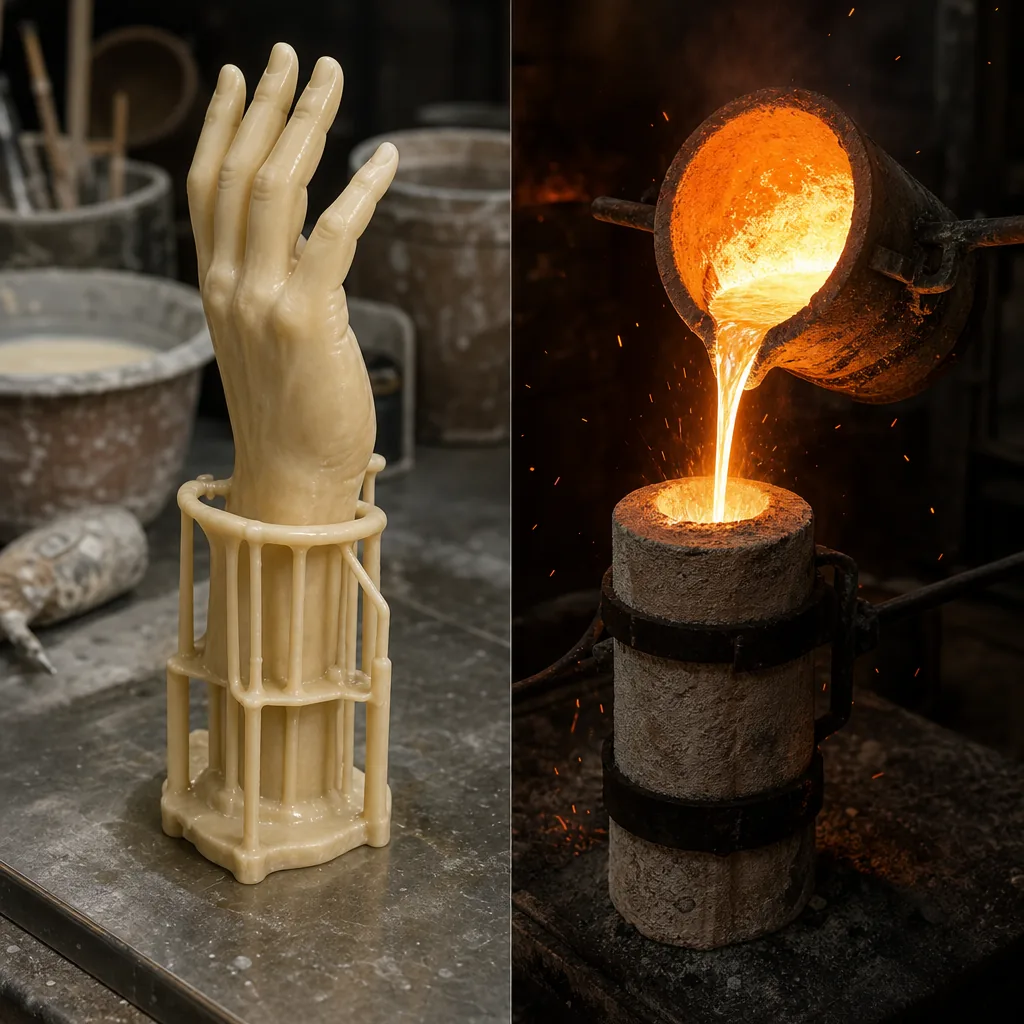
Lost-wax casting (cire perdue) is the dominant technique for fine art bronze and has remained essentially unchanged since ancient Mesopotamia. Understanding the process protects you as a buyer and deepens your appreciation of what you own.
Explore the work of Steve Gevurtz — limited-edition bronze figurative sculptures cast using traditional lost-wax methods, available exclusively through Dolphin Galleries. View the Steve Gevurtz Collection →
Step-by-Step: Lost-Wax Bronze Casting
Step 1 — Original Sculpture (the Master) The artist creates the original in clay, wax, or another modeling material. Every surface decision made here is permanent; the bronze will record it exactly.
Step 2 — Rubber Mold A flexible silicone or rubber mold is made over the original, capturing all surface detail. This mold allows multiple wax replicas to be produced — the foundation of limited-edition bronze production.
Step 3 — Wax Positive Hot wax is poured or painted into the rubber mold in layers, building a hollow wax shell approximately 3–6 mm thick. When removed, this wax positive is a perfect, flexible replica of the original.
Step 4 — Wax Chasing Skilled technicians (chasers) repair seam lines and imperfections in the wax by hand, using heated tools. The quality of this step determines how much finishing work will be required after casting.
Step 5 — Spruing Wax rods called "sprues" are attached to the wax positive. These form channels for molten bronze to flow in and for trapped gases to escape — their placement is an engineering decision that affects final quality.
Step 6 — Ceramic Shell Investment The wax assembly is dipped repeatedly into liquid ceramic slurry and coated with fine sand, building up a ceramic shell 6–12 layers thick over several days. This shell becomes the final mold.
Step 7 — Burnout (the "Lost Wax" Step) The ceramic-coated assembly is placed in a kiln at approximately 1,800°F (982°C). The wax melts and burns out, leaving a hollow negative ceramic mold. This is the "lost" in lost-wax.
Step 8 — Bronze Pour Bronze is melted in a crucible furnace to approximately 1,950–2,100°F (1,065–1,150°C) and poured into the hot ceramic shell. The shell must be warm to prevent thermal shock fractures.
Step 9 — Shell Breakout Once cooled, the ceramic shell is broken away — typically with hammers and sandblasting — revealing the raw bronze casting. For large works, pieces are cast in sections and welded together.
Step 10 — Metal Chasing and Finishing Metal chasers use grinders, files, chisels, and sandpaper to remove sprue marks, weld seams, and casting defects, restoring the artist's original surface texture. This is the most labor-intensive stage.
Step 11 — Patination Chemical patinas are applied using acids, heat, and metal salts to achieve the artist's intended final color. This is both a technical and aesthetic process. (See the full patina section below.)
Step 12 — Sealing and Waxing A final coat of paste wax (commonly microcrystalline or Renaissance Wax) is applied and buffed to protect the patina and provide a finished surface.
A single limited-edition bronze from concept to finished piece typically requires 8–16 weeks at a professional foundry. Large monumental works may require 12–24 months.
Types of Bronze Sculpture: A Complete Category Guide
Figurative Bronze Sculpture
Figurative bronze — the human form rendered in cast metal — is the oldest and most enduring category. It encompasses everything from life-size portrait statues to small desktop figures. Quality markers include anatomical accuracy, refined surface texture, confident pose composition, and a patina that enhances rather than obscures form. Price range: $800–$50,000+ depending on size, edition number, and artist reputation.
Animal and Wildlife Bronze Sculpture
Animal bronzes have sustained collector markets for over 150 years, from the French Animalier movement (Barye, Mêne) through contemporary wildlife artists. Eagles, horses, bears, and big cats dominate the category. Look for accurate musculature, dynamic posing, and well-executed fur or feather texturing. Price range: $500–$30,000+ for gallery-quality pieces.
Western Bronze Sculpture
Western bronze is a distinctly American genre documenting the mythology and reality of the frontier West: cowboys, Native Americans, horses, buffalo, and the landscape that defined them. It is one of the most actively collected regional art genres in the United States.
The canonical artists:
- Frederic Remington (1861–1909): The genre's founder. His Bronco Buster (1895) — a cowboy on a rearing horse — was the first American sculpture to be commercially reproduced in multiple casts and remains the archetype of the western bronze. Posthumous foundry casts vary enormously in quality and value.
- Charles M. Russell (1864–1926): Where Remington depicted drama and violence, Russell documented daily life with intimate knowledge of the range. His work is warmer in spirit and commands fierce loyalty from collectors.
- James Earle Fraser (1876–1953): Best known for The End of the Trail (1915) — the exhausted warrior on a spent horse — Fraser's work carries a melancholic dignity that distinguishes it from its peers.
What makes a western bronze valuable? Authorized lifetime casts and early posthumous casts supervised by the artist's estate command the highest premiums. Later commercial reproductions from secondary markets may lack foundry marks, have inconsistent patinas, or show loss of detail in high points — all red flags. Original maquettes (small-scale artist models) and casts numbered below 10 in a limited edition carry significant additional value.
Price range for quality western bronzes: $1,500 (small decorative) → $500,000+ (Remington lifetime cast).
Monumental Bronze Sculpture and Large Bronze Statues
Monumental bronze — life-size and larger — is the domain of public art commissions, memorials, institutional installations, and landmark architectural features. Works in this category are almost always custom commissions (see the commissioning section below) and involve collaboration between artist, foundry, structural engineer, and installation contractor.
Typical scale categories: - Life-size (5–7 ft): $15,000–$75,000 - Heroic scale (8–12 ft): $50,000–$250,000 - Monumental (12 ft+): $150,000–$1,000,000+
Structural reinforcement, stainless steel armatures, and purpose-built foundations add substantially to total project cost for outdoor large bronze statues.
Modern and Abstract Bronze Sculpture
Modern bronze sculpture broke decisively from representational form in the early 20th century. Key practitioners redefined what the medium could express:
- Constantin Brancusi (1876–1957): Reduced forms to essential geometry — his Bird in Space series asked what "flight" means as pure shape.
- Alberto Giacometti (1901–1966): Attenuated, spectral figures in bronze that externalize psychological isolation. Among the most expensive bronzes ever sold at auction.
- Henry Moore (1898–1986): Monumental abstracted organic forms, many sited in public spaces worldwide. His Family Group (1949) defined post-war figurative abstraction.
- Louise Bourgeois (1911–2010): Surrealist and psychologically charged bronze works, including the iconic Maman spider sculptures.
Contemporary abstract bronze sculpture has expanded further into mixed-media approaches: patinated bronze combined with stainless steel, glass, or stone; deliberately unfinished surfaces; deconstructed figurative forms. Abstract bronzes are assessed more on compositional strength, artist reputation, and edition documentation than on technical virtuosity alone.
Price range: $2,000 (small contemporary abstract) → $50,000,000+ (Giacometti auction records).
Bronze Relief Sculpture
Relief sculpture is cast bronze that projects from — or recedes into — a flat background panel. It encompasses three distinct types:
| Type | Projection Depth | Primary Use Cases |
|---|---|---|
| Bas-relief (low relief) | Less than 50% of subject depth | Commemorative plaques, architectural friezes, coins, medals |
| High relief | Greater than 50%; some elements nearly free-standing | Memorial panels, architectural façades, ceremonial doors |
| Sunken relief (intaglio) | Carved below the background plane | Rare in Western tradition; common in Egyptian and South Asian work |
Relief bronze is the default format for custom bronze plaques — memorial markers, building dedications, donor walls, mascot portraits, and historical markers. A well-executed bas-relief plaque combines portrait accuracy, legible letterforms, and a patina suited to its environment (typically brown or dark statuary for exterior plaques).
Pricing for relief work: $800–$5,000 for standard commemorative plaques; $10,000–$100,000+ for large architectural relief panels.
Bronze Figurines and Statuettes
Bronze figurines (typically under 12 inches) are the most accessible entry point to collecting. They range from mass-produced decorative imports to finely finished limited-edition works by represented gallery artists. The quality gap between these extremes is enormous — a $95 import figurine and a $1,200 gallery figurine may appear superficially similar in a photograph but differ dramatically in casting sharpness, patina application, edition documentation, and long-term value.
Markers of a quality bronze figurine: - Clean, sharp casting in fine detail areas (hair, hands, facial features) - Smooth, consistent patina with intentional color variation, not painted surface color - Foundry mark and edition number stamped or engraved on the base - Certificate of authenticity with artist signature - Solid weight relative to size
Price range: $400–$5,000 for limited-edition gallery figurines.
Bronze Fountains
Bronze fountains are among the most visually dramatic applications of cast metal, combining sculpture with hydraulic engineering. Tiered classical fountains, wildlife water features, and contemporary abstract fountain sculptures are all cast using the same lost-wax process. Outdoor placement requires UV-resistant sealant, non-corroding pump hardware, and winterization planning in freeze climates.
A Brief History of Bronze Sculpture
~2500 BCE — Prehistoric / Indus Valley: The Dancing Girl of Mohenjo-daro is among the world's oldest known cast bronze sculptures — a 4.5-inch figurine of a standing girl, lost-wax cast with extraordinary naturalism for her time.
~3000–500 BCE — Ancient Egypt, Mesopotamia, and Greece: Bronze worship statues, ritual vessels, and votive figurines proliferate. Greek bronzes (Riace Warriors, ~450 BCE) achieve a naturalism in posed human anatomy that would not be surpassed for centuries.
~500 BCE–400 CE — Classical Greece and Rome: Greek sculptors perfect the contrapposto pose in bronze. Roman demand for portrait sculpture drives industrial-scale bronze casting across the empire.
~500–1400 CE — Medieval Europe: The Gloucester Candlestick (c. 1107–1113) exemplifies Romanesque casting mastery. Cathedral doors in Hildesheim and Pisa demonstrate bronze's fitness for monumental architectural programs.
1400s–1600 CE — Renaissance Italy: Donatello's David (c. 1440s) becomes the first free-standing nude male bronze since antiquity. Lorenzo Ghiberti's Gates of Paradise (completed 1452) represents the apex of Renaissance relief casting. Verrocchio, Cellini, and Giambologna extend the tradition through Mannerism.
1600s–1800s — Baroque through Academic Sculpture: Bronze portrait statues of monarchs and generals proliferate across Europe and its colonies. The French Animalier movement (1830–1880) elevates animal bronze to a serious collector category.
1880–1910 — Rodin and the Modern Turn: Auguste Rodin's The Thinker (first large cast, 1902) redefines expressive potential in bronze — unidealized surfaces, psychological depth, architectural scale. Rodin's studio produced authorized editions of 12 for major works, establishing the modern limited-edition model.
1910–1970 — Modernism: Brancusi, Giacometti, Moore, Picasso, and Calder push bronze into pure abstraction, surrealism, and architectural integration. Bronze remains the prestige material even as new media proliferate.
1970–Present — Contemporary: Artists including Koons, Bourgeois, and Kapoor use bronze in dialogue with industrial fabrication and conceptual art. Meanwhile, a strong parallel market for traditional figurative and western bronze continues, sustained by collectors who value craft, narrative, and representational mastery.
Bronze Patina: A Buyer's Complete Guide
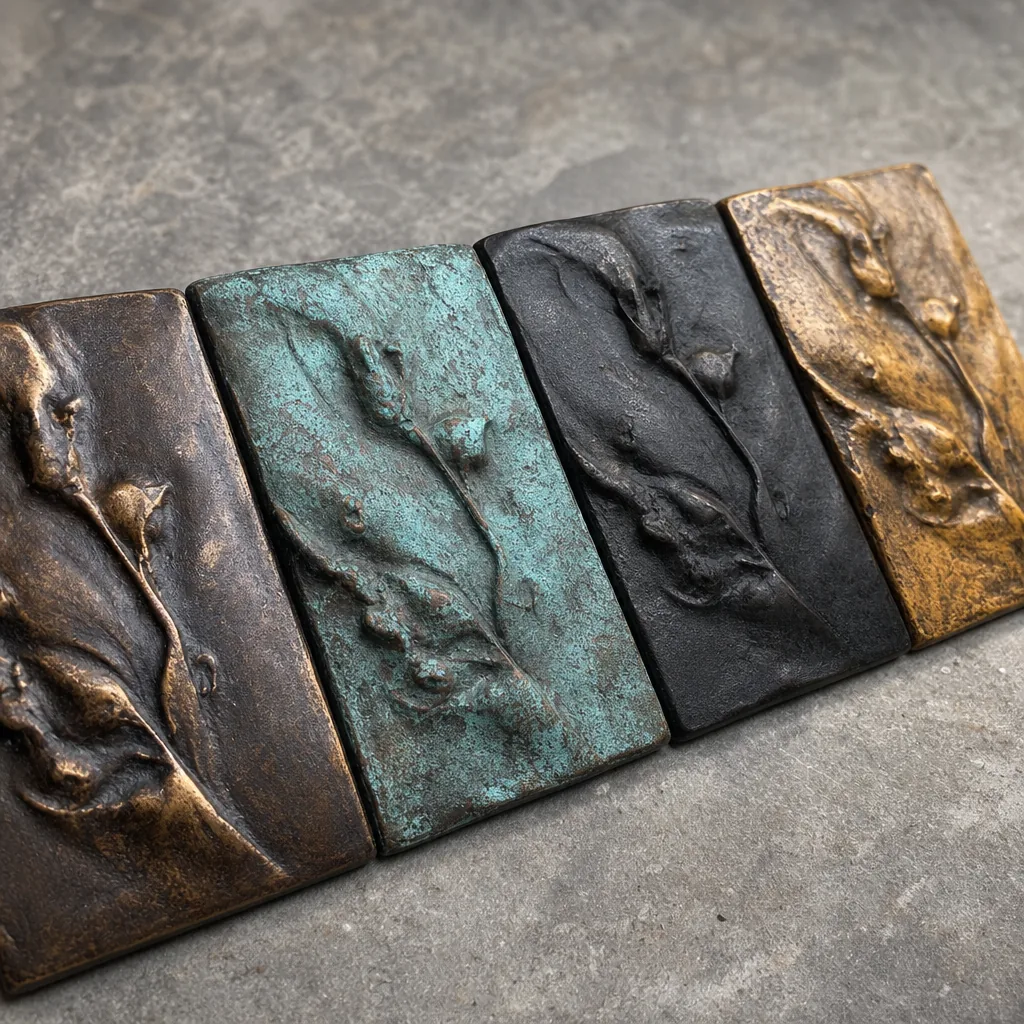
Patina is both the surface chemistry and the aesthetic signature of a bronze sculpture. Understanding it separates informed collectors from susceptible ones.
Natural vs. Chemical Patina
Natural patina develops through oxidation over decades or centuries. Outdoor bronzes in humid climates develop the iconic blue-green verdigris (copper carbonate/hydroxide) in as few as 10–20 years. Indoor bronzes develop a warmer brown oxide layer far more slowly. Natural patinas are prized for their authenticity and depth but cannot be controlled.
Chemical patina is applied during studio finishing using acids, heat, and metal salts to accelerate and direct the oxidation process. A skilled patinaire achieves precise, repeatable color with tonal depth that would take a century to develop naturally.
Patina Color Guide
| Color | Chemistry | Common Application |
|---|---|---|
| Verde / Green | Copper carbonate/chloride (cupric chloride + ammonia) | Outdoor monumental works, classical revival pieces |
| Brown (statuary) | Ferric nitrate + heat | Most common finish; warm, traditional, interior-friendly |
| Black (ebony) | Liver of sulfur (potassium polysulfide) | Contemporary, minimalist, high-contrast figurative work |
| Golden / Antique | Ferric nitrate + selenious acid | Trophy bronzes, commemorative plaques, western sculpture |
| Polychrome | Multiple chemicals applied in sequence | Contemporary mixed-color surfaces; highest skill requirement |
How Patina Affects Price and Authenticity
A professionally applied chemical patina represents 10–20% of a small bronze's total production cost. Recognizing fake painted patina — the most common fraud on decorative bronze imports — is essential:
- Authentic chemical patina shows tonal variation, semi-transparency, and different shades in recessed vs. raised areas. It cannot be rubbed off with a finger.
- Painted surface color applied over base metal looks flat, uniform, and opaque. It chips at edges under magnification and feels slightly plastic. It will rub off on a damp cotton swab over time.
- Run your fingernail across an inconspicuous raised area. Chemical patina is integral to the metal's surface; paint will catch and flake.
Maintaining and Restoring Patina
For both indoor and outdoor bronzes, a paste wax coat (Renaissance Wax, Johnson's Paste Wax, or similar microcrystalline formula) applied once or twice per year seals the patina against moisture and particulate. See our dedicated guide on how to clean bronze statues for a full step-by-step maintenance protocol.
How to Buy Bronze Sculpture: A Collector's Due-Diligence Guide
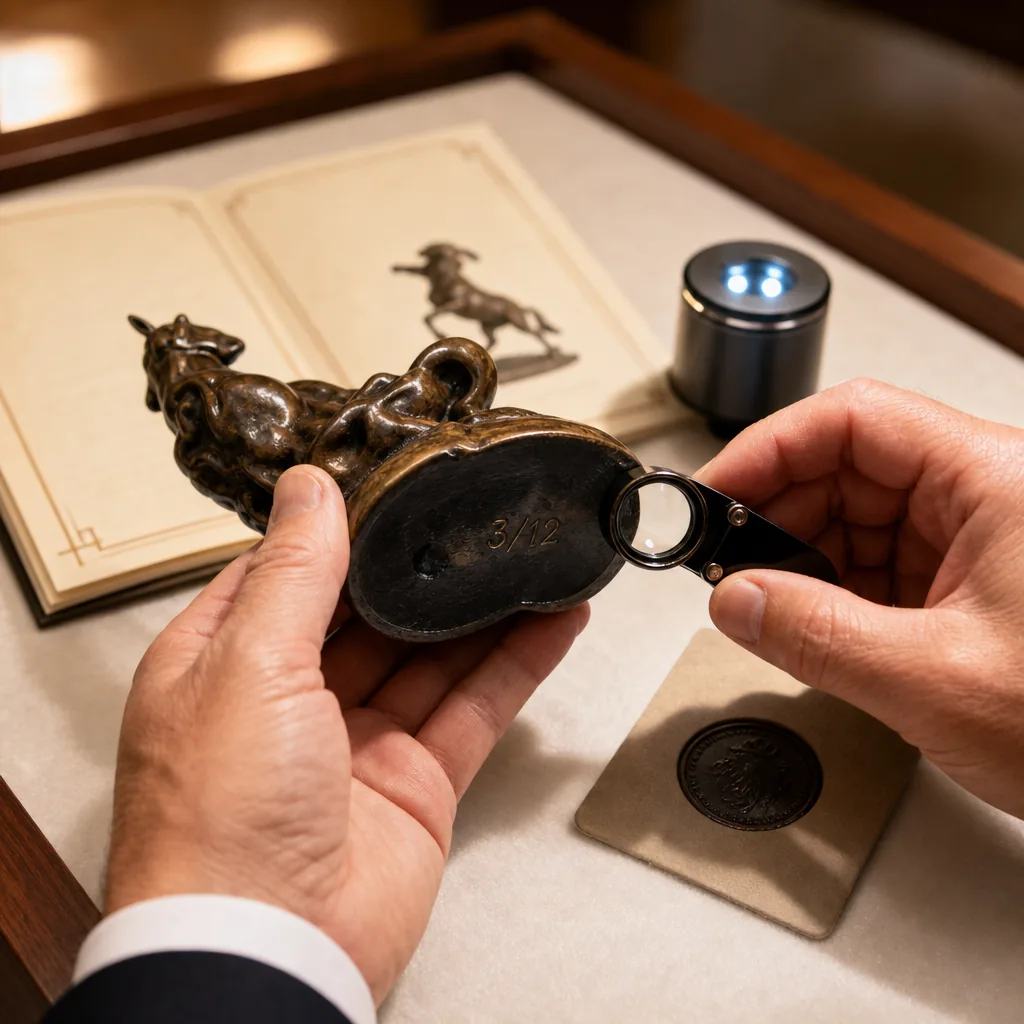
Limited Edition vs. Open Edition vs. Artist Proof
Limited edition: A fixed number of casts produced from one set of molds, certified by the artist and foundry. Standard editioning ranges from 6 to 25 casts for fine art bronzes; editions of 50, 99, or 200 exist in the decorative/commercial segment. Lower edition numbers = greater scarcity = stronger long-term value.
Open edition: No fixed limit on the number of casts. Common in decorative bronze, institutional awards, and commercial reproduction. Open editions rarely appreciate in value.
Artist Proof (AP): Traditionally, the first 10–15% of an edition set aside for the artist before numbered casts are released. An AP marked "AP 2/10" on a limited edition of 25 is outside the stated edition and typically carries premium collector value. Beware editions that inflate AP numbers far beyond the 10–15% convention.
Posthumous casts: Works cast after an artist's death using original molds. Their legitimacy depends entirely on estate authorization and foundry documentation. Rodin's posthumous market, for example, is tightly regulated by the Musée Rodin; many western bronze posthumous casts are poorly documented and carry murky provenance.
What to Look for Before You Buy
Foundry mark: A stamped or engraved mark identifying the casting foundry. Reputable foundries include Valsuani (Paris), Modern Art Foundry (New York), Tallix, and Shidoni (Santa Fe). Absence of a foundry mark on a supposedly significant bronze is a serious red flag.
Edition numbering: Look for "X/Y" stamped into the base — for example, "7/15" means the 7th cast in an edition of 15. The number should match the certificate of authenticity exactly.
Certificate of Authenticity (COA): Should include: artist name, title, edition number, foundry name, year of casting, and authorized signature. A COA from a reputable gallery adds a second layer of provenance.
Casting seams: Minor seams are acceptable and expected — they show the sculpture was cast in sections and welded, a sign of true bronze production. Perfect, seamless surfaces on complex forms may indicate resin casting. Visible grinding and chasing marks at weld points confirm metal-to-metal joinery.
Casting sharpness: Examine fine-detail areas — fingernails, facial features, hair, textile texture. In a quality bronze, these areas are crisp. In a worn mold or low-quality casting, they appear soft, blurred, or puddled.
Price Guide by Sculpture Type and Size
| Type / Size | Price Range |
|---|---|
| Desktop figurine, limited edition (under 12") | $400 – $3,000 |
| Mid-size figurative or animal (12"–30") | $1,500 – $15,000 |
| Large gallery bronze (30"–60") | $8,000 – $50,000 |
| Life-size sculpture (5–7 ft) | $15,000 – $100,000 |
| Heroic-scale outdoor bronze (8–12 ft) | $50,000 – $300,000 |
| Monumental public commission (12 ft+) | $150,000 – $1,000,000+ |
| Custom bronze plaque (standard) | $800 – $5,000 |
| Custom architectural relief panel | $10,000 – $100,000+ |
| Western bronze (quality gallery piece) | $1,500 – $500,000+ |
| Modern/abstract, emerging artist | $2,000 – $30,000 |
| Modern/abstract, established market | $20,000 – multi-million |
Custom Bronze Sculpture and Custom Bronze Plaques: The Commissioning Process
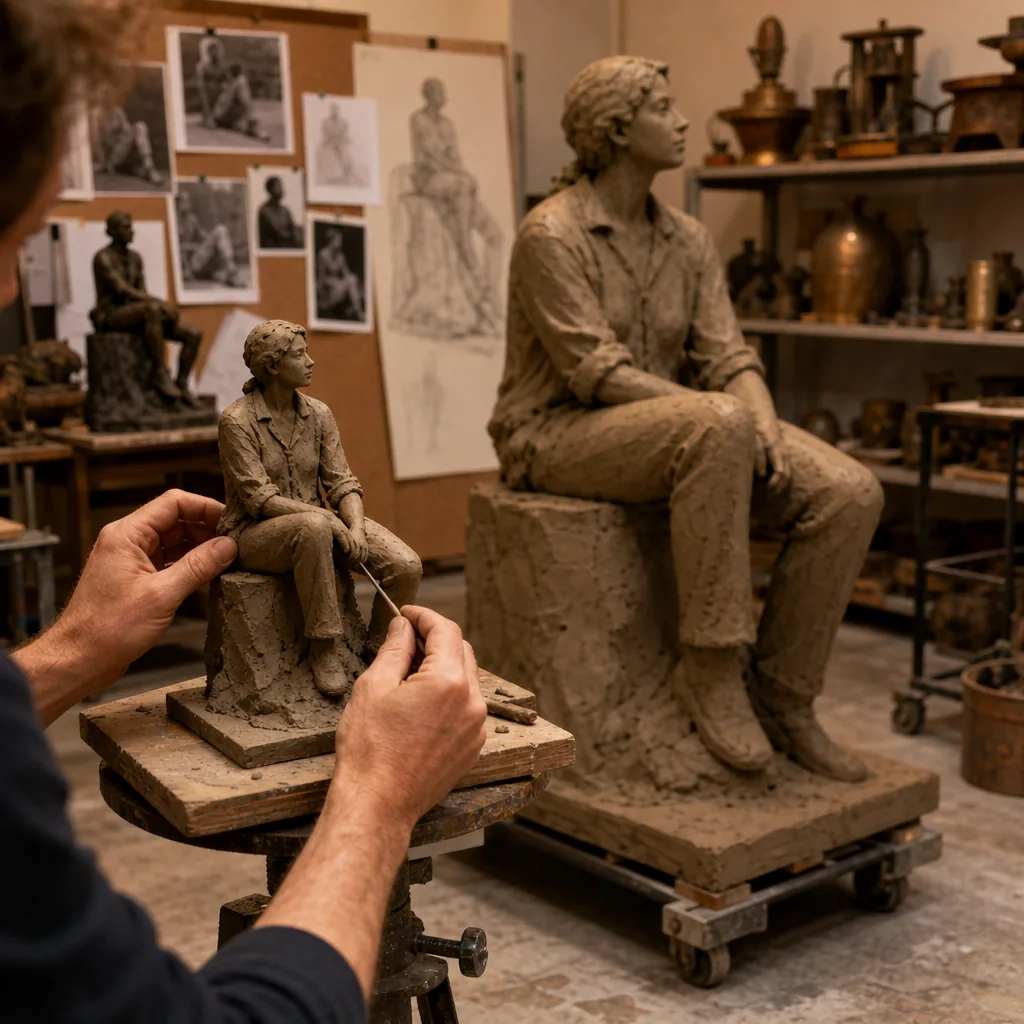
Commissioning a custom bronze — whether a life-size portrait, a custom bronze plaque for a building dedication, a corporate award sculpture, or a monumental public art installation — is a structured process, not an art project left to chance.
Step-by-Step Commissioning Guide
Step 1 — Define the Scope (Week 1–2) Provide the artist or foundry with: subject description (person, animal, concept, scene), intended dimensions, finish preferences (patina color, base material), installation environment (indoor/outdoor, climate zone), timeline, and budget.
Step 2 — Concept Sketch / Reference Material (Week 2–4) Gather high-quality photographs from multiple angles for portrait commissions. For figurative or narrative works, reference images, sketches, or a design brief should be provided. The more specific your reference, the more accurate the final result.
Step 3 — Maquette (Small-Scale Model) (Month 1–3) The artist creates a scaled-down maquette — typically 1:4 or 1:8 scale — in clay or wax for client review and approval. This is the most cost-efficient point to request revisions. Changes after this stage increase cost significantly.
Step 4 — Approval and Deposit Client approves the maquette and signs a commission agreement. A deposit of typically 40–50% of total commission cost is standard at this stage.
Step 5 — Full-Scale Sculpting and Casting (Month 3–10) The artist scales the approved design to final dimensions, creates the full clay or wax model, and delivers it to the foundry for mold-making and bronze casting per the lost-wax process above.
Step 6 — Review Casting and Finishing Approval For significant commissions, clients may review the raw casting before patination. Final patina color is approved at this stage.
Step 7 — Delivery, Base, and Installation (Month 10–12+) Large bronzes ship by freight on custom crating. Site preparation — concrete pads, anchor bolts, drainage considerations — must be completed before delivery. Professional installation by a bronze art handler is strongly recommended for works over 200 lbs.
What Clients Must Provide
For a custom bronze plaque: Finalized text (name, dates, inscription), portrait photograph(s) if applicable, mounting surface type (granite, brick, concrete), desired dimensions, and plaque shape.
For a portrait or figurative commission: Multiple reference photographs (face, full body, clothing, characteristic poses), any existing sculptures or images of the subject, and a written description of the character, narrative, or emotional quality you want the work to convey.
Timeline Expectations
| Project Type | Typical Timeline |
|---|---|
| Standard bronze plaque | 8–14 weeks |
| Small figurative commission (under 24") | 3–6 months |
| Life-size portrait or figurative | 6–12 months |
| Heroic/monumental commission | 12–24 months |
Outdoor vs. Indoor Bronze Sculpture: Placement Considerations
Outdoor Bronze
Outdoor bronze weathers beautifully but requires proactive maintenance:
- Verde patina development: Green copper carbonate begins forming within 5–20 years depending on humidity, coastal salt air, and acid rain exposure. This is natural and protective — it does not indicate damage.
- Sealant schedule: Apply Renaissance Wax or microcrystalline paste wax twice per year (spring and fall) for outdoor bronzes. In coastal salt environments, increase to three times per year.
- UV effects: True bronze is UV-stable, but any painted accent or lacquer coating will degrade. Avoid lacquer on outdoor bronzes entirely; it traps moisture and accelerates corrosion beneath the surface.
- Climate considerations: In freeze-thaw climates, ensure drainage holes are present on hollow castings to prevent water accumulation and ice expansion. Bronze itself is not harmed by freezing, but trapped water can crack a poorly designed piece.
- Mounting: Life-size and larger outdoor bronzes require stainless steel anchor bolts set in concrete footings, typically engineered to local wind-load codes. Consult a structural engineer for works over 200 lbs or in high-wind zones.
Indoor Bronze
Indoor bronzes are dramatically lower-maintenance. Keep them away from: - Sustained direct sunlight through windows (fades and bleaches patina over years) - High-humidity environments (bathrooms, unventilated basements) - Household cleaning chemicals, which can strip patina permanently
Dust with a soft dry cloth. Apply a light wax coat every 1–2 years. Never use abrasive cleaners, acidic agents, or commercial metal polishes — all are damaging to patina.
Care and Maintenance of Bronze Sculpture
Proper care is simple but specific. The enemies of bronze are not time — they are moisture, salt, abrasion, and wrong chemicals.
Indoor Bronze Care Schedule
| Frequency | Task |
|---|---|
| Monthly | Dust with dry microfiber cloth |
| Annually | Apply thin coat of Renaissance Wax, buff to low sheen |
| As needed | Clean with distilled water and mild dish soap on soft cloth; rinse, dry immediately |
Outdoor Bronze Care Schedule
| Frequency | Task |
|---|---|
| Twice yearly | Full clean + Renaissance Wax reapplication |
| After severe weather | Inspect for debris accumulation; clear drainage holes |
| Every 5–10 years | Professional patina restoration if color has shifted undesirably |
Never use: Steel wool, Brillo pads, vinegar, bleach, WD-40, or any commercial brass/copper polish on a fine art bronze. These will strip, abrade, or chemically alter the patina irreversibly.
For a comprehensive protocol, see our dedicated guide on how to clean bronze statues.
Explore Limited-Edition Bronze Sculpture at Dolphin Galleries
Dolphin Galleries represents Steve Gevurtz, whose limited-edition cast bronze figurative sculptures exemplify everything this guide describes: lost-wax casting precision, artisan chemical patination, strict edition numbering, and full certificates of authenticity. If this guide has sharpened your eye for what distinguishes an exceptional bronze from an ordinary one, Gevurtz's work is a natural next destination.
