

Bronze Dog Statues: The Complete Buyer's Guide to Breeds, Materials, Sizing & Custom Commissions
A bronze dog statue is one of the few art purchases that earns emotional resonance and outlasts the buyer. True lost-wax bronze — the same casting technique used since ancient Egypt — produces a sculpture that can weather a century of seasons outdoors without structural degradation. Yet the market is cluttered with look-alike pieces cast in resin, cast stone, and brass that carry "bronze" in their product names while offering a fraction of the longevity. This guide cuts through that confusion completely.
Whether you're searching for a life-size bronze Golden Retriever for a garden gate, a tabletop Whippet for a study, a resting "lazy dog" sculpture for a sunroom, or a custom portrait memorial of a specific animal you loved, the sections below give you the factual framework — materials, pricing, sizing, breed availability, outdoor care, and the commission process — to make a confident, well-informed purchase.
Bronze vs. Cold-Cast Resin vs. Brass vs. Cast Stone: What You're Actually Buying
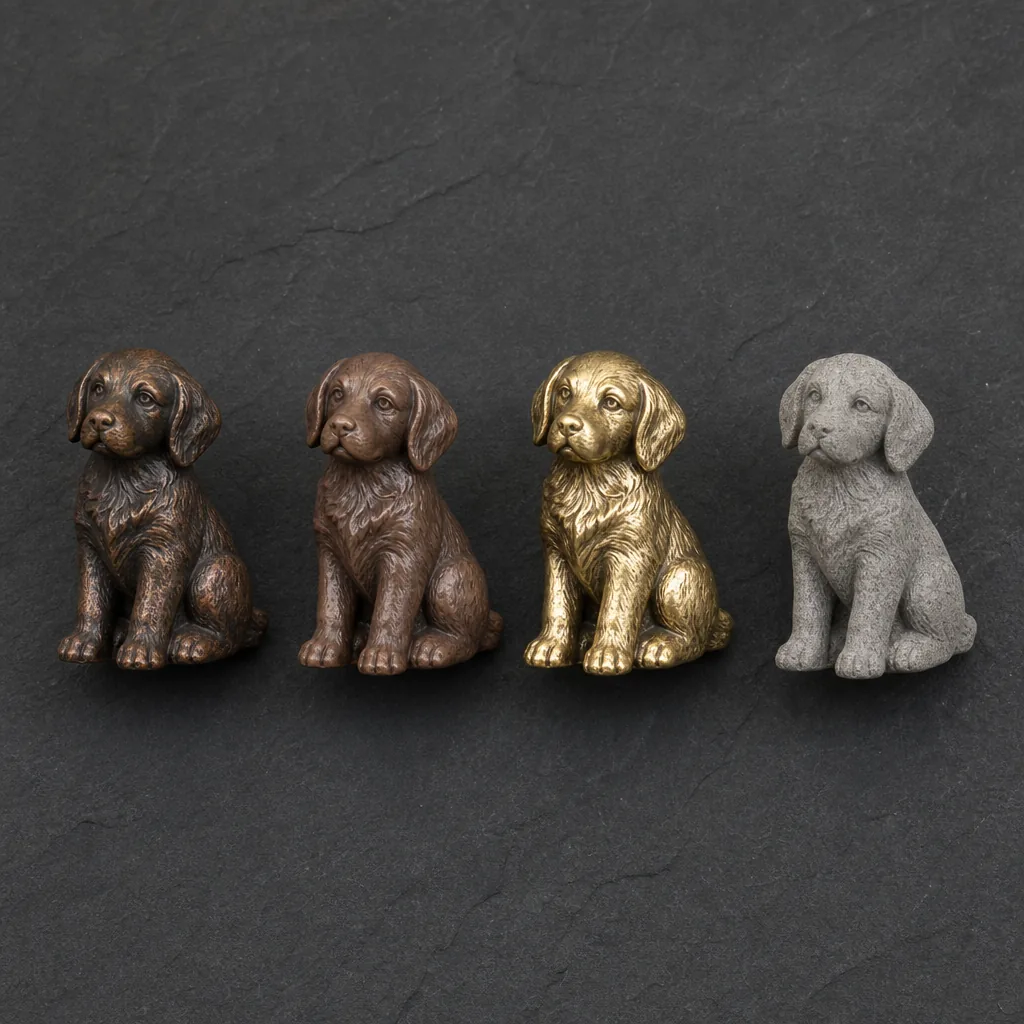
The single greatest source of buyer regret in the dog sculpture market is purchasing cold-cast resin while believing it is solid bronze. The material distinction is not cosmetic — it determines durability, weight, outdoor suitability, investment value, and authenticity.
The Four Materials Explained
True Bronze (Lost-Wax or Sand Cast) Solid silicon bronze alloy (typically 95% copper, 4% tin, 1% zinc) poured into a ceramic shell or sand mold. The lost-wax (cire perdue) method begins with the sculptor's original clay or wax model, builds a heat-resistant ceramic investment around it, burns the wax out, and pours molten metal in its place. Each piece is individually chased, welded, and patinated by hand. This is the only material that justifiably commands gallery pricing.
Cold-Cast Bronze Resin Polyurethane or polyester resin mixed with bronze powder — sometimes as little as 10–30% metal by weight. The powder gives a metallic surface that polishes convincingly, but the core is plastic. It can be damaged by frost, direct UV, and physical impact in ways solid bronze cannot. Most pieces under $300 labeled "bronze" are cold-cast resin.
Brass A copper-zinc alloy (typically 67% copper, 33% zinc) that is harder, more golden in tone, and less traditional in fine-art sculpture than bronze. Decorative hardware, door knockers, and mass-produced garden ornaments commonly use brass. It does not patinate in the same warm, complex way bronze does, and it is rarely used by fine-art sculptors for large-scale work.
Cast Stone / Cement Composite Aggregate and cement mixtures pressed or poured into molds. Heavier than resin, less durable than bronze, and prone to spalling in freeze-thaw cycles. Sometimes sold as "life-size bronze" collections alongside true bronze with no disclosure of the difference — a practice that undermines buyer trust entirely.
Material Comparison Table
| Material | Typical Weight (12" figure) | Outdoor Durability | Price Range | Customizable? | Best Use |
|---|---|---|---|---|---|
| True bronze (lost-wax) | 8–18 lbs | Excellent — 100+ years | $400–$25,000+ | Yes (full custom) | Fine art, memorial, garden, institutional |
| Cold-cast bronze resin | 2–5 lbs | Poor — 3–10 years | $50–$600 | Limited | Indoor décor, gifts |
| Brass | 10–20 lbs | Good — corrosion-resistant but not art-grade | $80–$800 | Very limited | Hardware, door ornaments |
| Cast stone / cement | 15–40 lbs | Fair — susceptible to frost spalling | $100–$1,200 | No | Low-maintenance garden ornament |
Buyer's rule of thumb: If a piece is marketed as bronze and costs under $200, verify the casting method in writing before purchasing. Ask: "Is this solid silicon bronze, lost-wax or sand cast?" A reputable gallery or foundry will answer immediately and specifically.
Price Ranges for Bronze Dog Statues: What Drives Cost Up and Down
Explore Chris Barela's Marine Bronzes at Dolphin Galleries Chris Barela's limited-edition bronze sculptures represent the gold standard of fine-art lost-wax casting — each piece signed, numbered, and cast in solid silicon bronze. If the craftsmanship and authenticity described in this guide matter to you, browse the Chris Barela collection at Dolphin Galleries to see what genuine fine-art bronze looks like in practice.
Pricing in the bronze dog sculpture market spans a factor of more than 100× between the cheapest decorative pieces and museum-quality commissions. Here is an honest breakdown of what each tier actually delivers.
Tabletop & Decorative ($100–$600)
These are almost universally cold-cast resin or small solid brass pieces. Dimensions typically run 4–10 inches. Appropriate for indoor shelves, desks, and gifting. Do not use outdoors year-round; UV and frost will degrade the resin binder within a few seasons. Fine as decorative objects — misleading only when sold as "bronze" without material disclosure.
Garden-Scale ($600–$3,500)
This is where the market begins to stratify sharply. At the low end ($600–$1,200), you'll find sand-cast bronze imports, often from Chinese foundries, with adequate but inconsistent patina work and limited artist provenance. At $1,500–$3,500, domestic studio bronzes and limited-edition gallery pieces enter the range — lost-wax cast, hand-chased, and properly patinated. A sitting Labrador at 18–24 inches from a reputable American studio typically falls here. These pieces perform outdoors with basic annual maintenance.
Life-Size ($3,500–$12,000)
A life-size Labrador Retriever in true lost-wax bronze typically ranges from $4,000–$6,500 from a domestic studio with documented provenance. A Great Dane — significantly more bronze by volume — will run $8,000–$12,000. These are gallery-tier acquisitions. Expect foundry certificates, edition numbers, artist signatures, and a documented patina specification. Shipping requires a crate and freight carrier; budget $300–$800 for delivery depending on distance and weight (a life-size dog statue can weigh 80–200+ lbs).
Monumental & Custom ($12,000–$25,000+)
Institutional commissions, park installations, estate centrepieces, and fully customized portrait statues of specific dogs occupy this tier. Monumental bronzes require engineered bases, ground anchoring, and in some cases structural permits. Price scales directly with the volume of bronze poured, the complexity of the pose, the sculptor's reputation, and the edition size (one-of-a-kind vs. limited edition of 25).
What Pushes Price Up
- Lost-wax vs. sand cast (lost-wax is more labor-intensive, typically 15–25% higher)
- USA or European foundry vs. overseas (domestic labor adds cost but typically improves QC and artist oversight)
- Edition size: smaller editions command higher per-piece prices
- Pose complexity: a pointing dog with a raised leg is structurally harder to cast than a sitting dog
- Patina complexity: three-tone finishes cost more than a single dark-brown standard
Breed Availability Guide: Ready-Made vs. Custom Commission
Not all breeds are equally available as ready-made bronzes. Below is a practical guide to the 20 most commonly sculpted breeds, their availability status, and realistic lead times when a custom commission is required.
Breeds Typically Available as Ready-Made Gallery Pieces
These breeds have sufficient market demand that multiple sculptors maintain them in production editions:
| Breed | Common Poses Available | Typical Ready-Made Size Range |
|---|---|---|
| Labrador Retriever | Sitting, standing, retrieving, resting | 6"–life-size |
| Golden Retriever | Sitting, standing, running | 8"–life-size |
| German Shepherd | Standing alert, sitting, lying | 10"–life-size |
| English Bulldog | Sitting, standing | 6"–24" |
| Boxer | Standing, sitting | 8"–36" |
| Whippet / Greyhound | Resting, standing, running | 8"–life-size |
| Cocker Spaniel | Sitting, standing | 6"–20" |
| Beagle | Standing, sitting, nose-down | 6"–20" |
| Dachshund | Standing, lying | 4"–18" |
| Border Collie | Crouching, standing | 8"–24" |
| Doberman | Standing alert | 10"–life-size |
| Great Dane | Standing, sitting | 12"–life-size |
| Pointer / Vizsla | Pointing, standing | 8"–life-size |
| Irish Setter | Standing, running | 8"–24" |
| Rottweiler | Standing, sitting | 10"–30" |
Breeds That Typically Require Custom Commission
Less commercially produced but frequently requested: - Rhodesian Ridgeback, Weimaraner, Basenji, Leonberger, Anatolian Shepherd, Plott Hound, Norwegian Elkhound, Xoloitzcuintli, and most rare/working breeds
Custom commission lead time by breed complexity: - Standard breed, standard pose (e.g., sitting Labrador): 3–5 months - Standard breed, complex pose (e.g., leaping Springer Spaniel): 5–7 months - Rare breed or portrait likeness from photos: 6–9 months - Monumental/life-size rare breed: 9–14 months
Bronze Golden Retriever Statue: The Most-Requested Breed
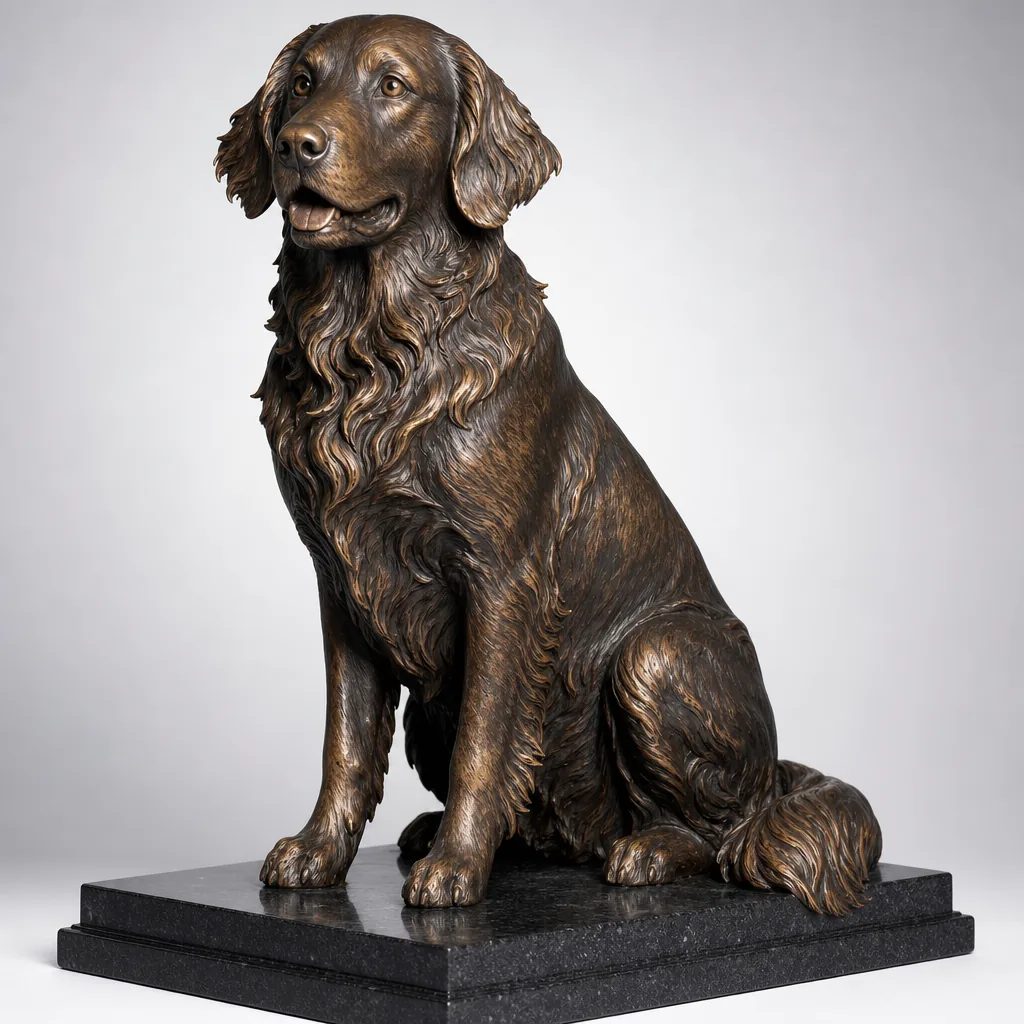
The Golden Retriever is consistently the most-searched breed in the bronze dog statue market, and for good reason — the breed's flowing coat, athletic build, and expressive face translate beautifully into patinated bronze. The contrast between the sculpture's dark-brown or verde patina and the implied warmth of the original golden coat creates a visually compelling tension that collectors and garden designers both prize.
What to Look For in a Bronze Golden Retriever Statue
- Coat texture: Lost-wax cast Goldens should show individual fur strand separation, particularly around the ears, chest ruffs, and tail plume. Cold-cast pieces tend to have blurred, washed-out fur detail.
- Proportional accuracy: A Golden's head-to-body ratio, the depth of the chest, and the angle of the hindquarters are breed-specific checkpoints. Ask the gallery for a breed standard comparison if in doubt.
- Pose selection: Sitting Goldens are the most popular for memorials and entryways. Standing Goldens with head up and ears forward work well flanking garden gates. Running or retrieving poses suit larger garden installations.
- Size for garden use: A 24–30 inch standing Golden is proportionally accurate for most medium-large garden settings. A life-size Golden stands approximately 21–24 inches at the shoulder.
Bronze Whippet, Greyhound & Sighthound Sculptures
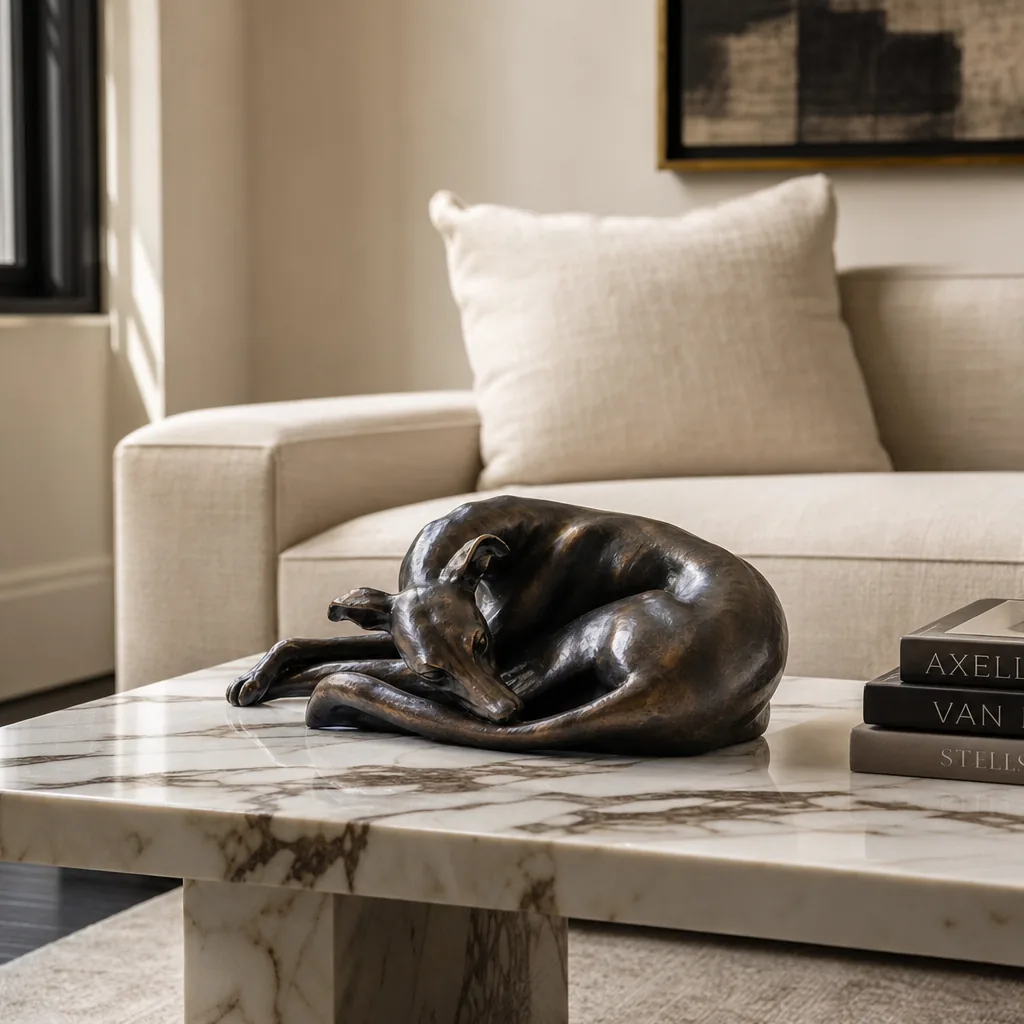
Whippets and Greyhounds occupy a distinct collector niche within the bronze dog sculpture world. Their aerodynamic profiles — deep chest, tucked abdomen, arched loin, long tapering skull — make them among the most architecturally striking subjects in bronze. The Whippet in particular has become almost a design object in its own right, appearing in interior design contexts as frequently as garden settings.
Resting / "Lazy Dog" Pose: A Sub-Category of Its Own
The resting sighthound — Whippet or Greyhound curled nose-to-tail, or stretched long in a "dead dog" sphinx pose — deserves its own section because it is the most consistently underserved style in the ready-made market yet among the most searched.
Why the resting pose works so well in bronze: - The compressed, self-contained form is structurally strong (no extended limbs to snap or stress) - It reads beautifully from above, making it ideal for coffee table, hearth, or low garden plinth placement - The resting pose carries emotional weight — it suggests peace, trust, and the quiet intimacy of a dog at rest — which is why it is frequently chosen for memorial pieces
Placement recommendations for resting / lazy dog bronze sculptures: - Living room coffee table or hearth ledge (12–18" pieces at eye level when seated) - Garden bed border or low stone plinth (24–36" pieces) - Beside a doorstep or at the foot of garden stairs - Library or study on a book-level shelf
The resting pose also suits mixed-breed or non-specific "hound type" sculptures particularly well, since the form is evocative without requiring breed precision — making it a strong choice for memorial pieces where the feeling of the dog matters more than exactbreeed accuracy.
Life-Size Bronze Dog Statues: Sizing Decision Framework
"Life-size" means something very different for a Chihuahua (4–6 lbs, 5" at the shoulder) than a Great Dane (100–180 lbs, 28–32" at the shoulder). Before specifying a life-size commission or purchasing a labeled "life-size" piece, use the framework below.
Breed Shoulder Height Reference Chart
| Breed | Shoulder Height | Life-Size Statue Weight (Bronze) | Recommended Base |
|---|---|---|---|
| Chihuahua | 5–8" | 4–8 lbs | Tabletop / small plinth |
| Dachshund (standard) | 8–9" | 6–12 lbs | Tabletop / garden plinth |
| Beagle | 13–15" | 15–25 lbs | Garden plinth / foyer |
| Cocker Spaniel | 14–15" | 18–28 lbs | Garden plinth / foyer |
| Border Collie | 18–22" | 35–55 lbs | Garden plinth / foyer |
| Labrador Retriever | 21–24" | 55–90 lbs | Anchored garden plinth |
| Golden Retriever | 21–24" | 55–90 lbs | Anchored garden plinth |
| German Shepherd | 22–26" | 65–100 lbs | Anchored garden plinth |
| Boxer | 21–25" | 55–85 lbs | Anchored garden plinth |
| Great Dane | 28–32" | 120–200 lbs | Engineered base required |
How to Match Statue Size to Installation Space
- Foyer or entryway: A sitting dog at 60–70% of life-size reads naturally at human eye level when entering. A full life-size dog in a standard foyer can feel overwhelming — scale down unless the space is grand.
- Garden flanking a gate or path: Life-size standing figures on raised plinths (8–12" base) are proportionally correct at viewing distances of 10–20 feet. Scale up slightly (110–120% of life-size) for installations viewed from 30+ feet.
- Garden bed accent: Resting or sitting dogs at 50–75% of life-size integrate into planting schemes without dominating. Full life-size pieces become focal points and need clear sightlines.
- Institutional / park: Scale up to 110–150% of life-size for installations on lawns or plazas viewed from distance. Monumental scale (200%+) requires engineering review.
Outdoor Durability & Bronze Care: What Actually Happens Over Time
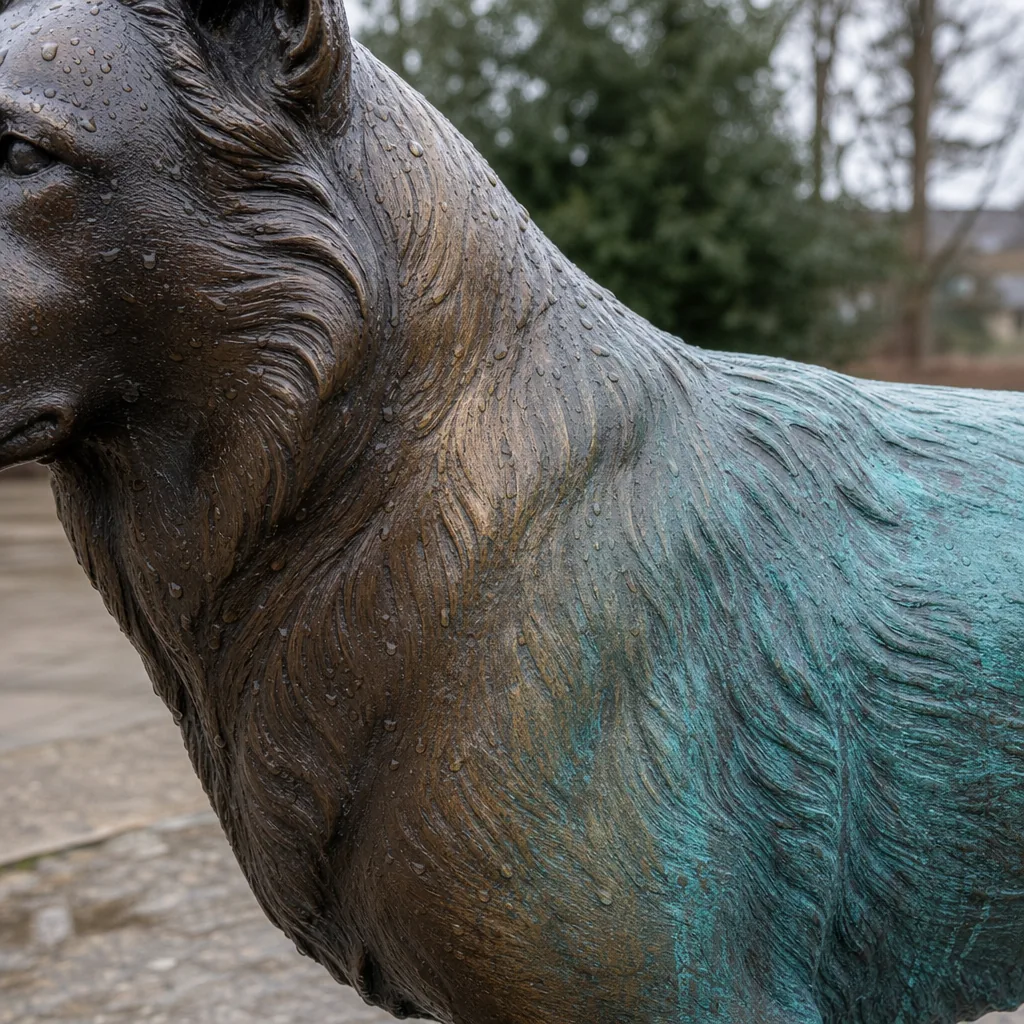
Bronze is among the most outdoor-durable artistic materials available, but "durable" does not mean "maintenance-free." Understanding how bronze ages outdoors — and what annual care prevents premature degradation — is the difference between a sculpture that improves with age and one that looks neglected within a decade.
How Bronze Patina Develops Outdoors
The patina on a new bronze sculpture is applied by the foundry using chemicals (ferric nitrate, liver of sulfur, cupric nitrate) heated into the surface. This applied patina — typically dark brown (bistre), black (ebony), or verde (blue-green) — is a thin, controlled oxide layer. Over time, exposure to rain, humidity, oxygen, and pollutants causes the patina to evolve:
- Year 1–2: Applied patina stabilizes; light highlights appear on raised surfaces from handling and rain
- Year 2–5: Natural verdigris (basic copper carbonate) begins forming in recessed areas and on horizontal surfaces that collect moisture — particularly in humid or coastal environments
- Year 5–15: A stable natural patina develops; color varies from chocolate brown to blue-green depending on climate, alloy, and maintenance frequency
- Coastal environments: Salt-air accelerates verdigris formation; expect significant greening within 2–4 years
Annual Maintenance Schedule
Spring (post-winter): 1. Wash with mild soap and water, rinse thoroughly 2. Inspect for any white or gray crystalline deposits (chloride attack — requires neutralization with distilled water and baking soda solution) 3. Apply a thin coat of paste wax (Renaissance Wax or Johnson's Paste Wax) to all surfaces; buff to a light sheen 4. Check base anchoring hardware for corrosion
Fall (pre-winter): 1. Repeat wash and wax application 2. For sculptures in freeze-thaw climates: ensure water cannot pool in hollow areas (drainage holes should be clear) 3. Cover or move tabletop resin pieces indoors — this step is unnecessary for true bronze
Freeze-Thaw Performance
True silicon bronze is not damaged by freezing temperatures. The metal contracts slightly in cold and expands in heat — this is normal and does not cause structural damage in properly cast pieces. The risk in cold climates is water infiltrating cracks in a stone or concrete base, not the bronze itself. Ensure your pedestal is frost-resistant (granite and cast iron are both appropriate; porous limestone and unreinforced concrete are not).
UV Performance
Bronze does not degrade from UV exposure in the way resin, paint, or colorized coatings do. The one caveat: any clear lacquer applied over the patina (some foundries do this; most fine-art foundries do not) will yellow and peel with UV exposure. If your piece has a lacquered finish, that layer will need reapplication every 3–5 years or stripping and rewaxing.
Hunting Dog & Working / Military K9 Bronze Sculptures
Hunting dog and working dog bronzes occupy a proud tradition in fine-art sculpture — from Remington's iconic retrievers to contemporary sporting estate commissions. The category has distinct sub-niches that reward some specific buyer knowledge.
Hunting Dog Poses and Their Contexts
Pointing pose (one foreleg raised, body rigid, nose forward): The quintessential sporting bronze. Appropriate for libraries, studies, gun rooms, and sporting estates. Most commonly executed in Pointer, Vizsla, Weimaraner, and English Setter breeds. Structurally demanding — the raised leg must be engineered to bear the cantilevered weight of the body, which is why quality casting matters more here than in a simple sitting pose. Expect to pay a 20–30% premium over a standing or sitting pose of equivalent size.
Flushing pose (dog lunging forward, head low, driving birds from cover): More dynamic and spatially demanding than pointing. Best suited to larger indoor settings (great halls, sporting lodges) or outdoor plinths with clear 360° sightlines.
Retrieving pose (dog returning with game or dummy): Emotionally warm and accessible — works well in both sporting and domestic contexts. A natural subject for Labrador and Golden Retriever memorial bronzes.
Military and Police K9 Memorials
K9 memorial commissions for police departments, military units, and fire departments are a growing institutional sub-category. These commissions typically feature: - A specific breed (Belgian Malinois, German Shepherd, or Labrador) in working posture - An inscription plaque integrated into the base - Edition size of one (unique piece) - Installation on a public site with municipal permitting requirements
Budget $8,000–$20,000+ for a documented institutional K9 commission in true lost-wax bronze, depending on size and complexity.
Memorial Bronze Dog Statues: Honoring a Specific Animal
A memorial bronze is one of the most meaningful purchases a dog owner can make — and one of the most emotionally high-stakes. The decisions below make a significant difference in whether the final piece truly honors the animal.
Portrait Likeness vs. Breed-Generic Statue
Portrait likeness (sculpted from photographs of your specific dog): Captures the individual animal — the particular set of the ears, the way the dog carried its head, any distinctive markings conveyed through patina variation. Requires 8–15 high-resolution reference photographs from multiple angles (see custom commission section below). Costs 30–60% more than a breed-generic piece of comparable size.
Breed-generic statue: A well-sculpted breed-accurate bronze that evokes the type without being a portrait. A strong choice when the memorial focus is on the relationship and breed character rather than an exact likeness. Often available ready-made, which matters when grief is fresh and a 6-month commission timeline is emotionally difficult.
Inscription Plates and Pedestal Options
- Integrated base plate: The inscription is cast directly into the bronze base — the most permanent and aesthetically unified option. Must be specified before casting; cannot be added afterward.
- Applied plate: A separate engraved brass or bronze plate mounted to the sculpture base or a secondary pedestal. Can be commissioned independently and attached to a ready-made statue, making it a practical option for non-custom pieces.
- Pedestal materials: Granite (most durable, frost-resistant, premium appearance), black absolute granite (striking contrast with bronze patina), limestone (elegant but requires sealing), cast stone (cost-effective but not frost-proof without treatment), hardwood (indoor only)
Note: For detailed guidance on bronze plaques and inscription options specifically, dedicated resources on bronze plaques are worth exploring separately — that topic has its own technical depth around font selection, relief depth, and mounting hardware.
Pose & Style Sub-Categories: Matching Sculpture to Setting
| Pose | Emotional Tone | Best Placement | Space Required |
|---|---|---|---|
| Sitting | Dignified, welcoming | Entryway, foyer, memorial | Small–medium |
| Standing alert | Proud, guardian | Gate flanking, institutional | Medium–large |
| Resting / lazy | Intimate, peaceful | Living room, garden bed, memorial | Small–medium |
| Running / leaping | Joyful, dynamic | Large garden, open lawn | Large, open sightlines |
| Pointing / hunting | Sporting, traditional | Study, library, sporting estate | Medium–large |
| Flushing | Dramatic, kinetic | Great hall, open garden | Large |
| Retrieving | Warm, loyal | Garden, entryway, memorial | Medium |
| Nose-down / tracking | Focused, working | Study, sporting estate | Small–medium |
Custom Bronze Dog Statue: The Commission Process End to End
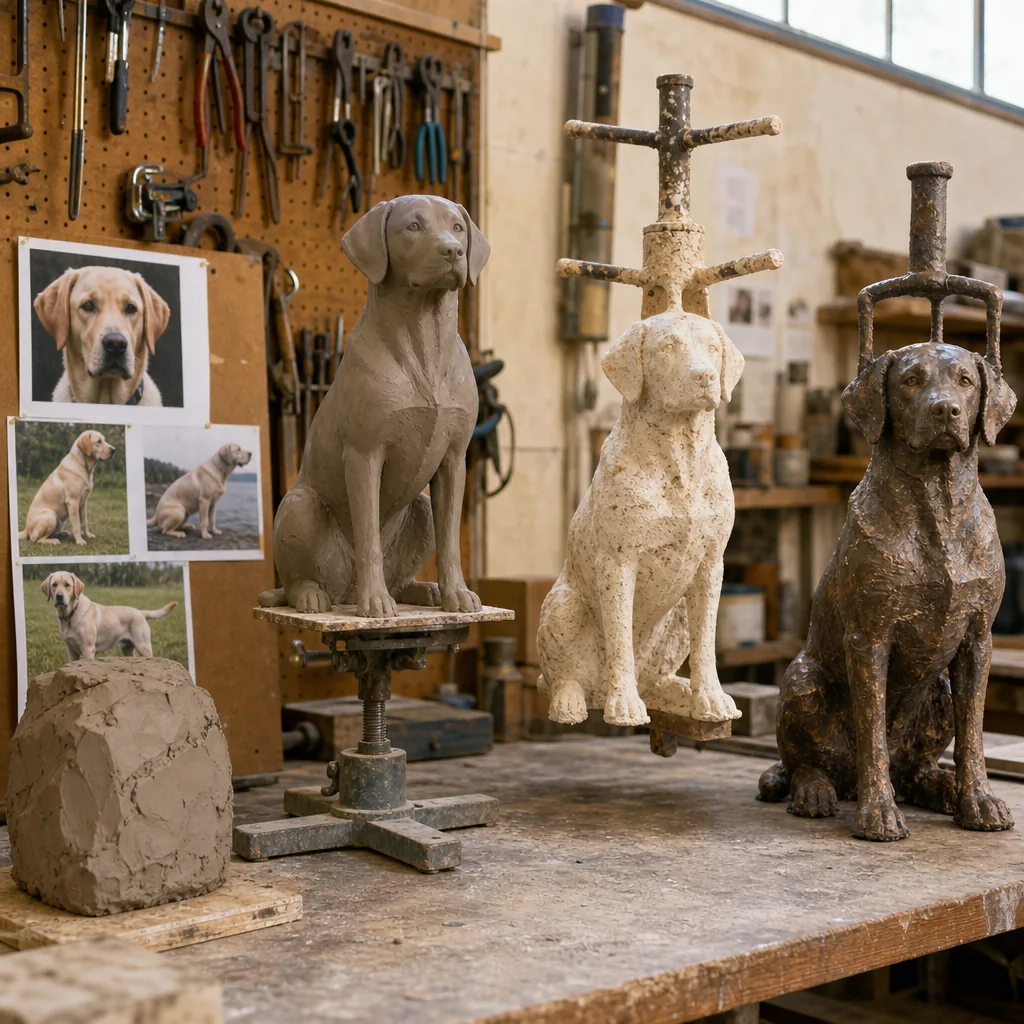
Commissioning a custom bronze dog sculpture is one of the most rewarding acquisitions in fine art — and one of the most misunderstood processes among first-time buyers. Here is exactly what the process involves.
Step 1: Reference Photography
The sculptor needs 8–15 high-resolution photographs of the subject dog: - Both sides (left and right profile, full body) - Front face on - Rear three-quarter view - Top-down view (reveals back and ear set) - Close-up of face, ears, and paws - The dog standing on a flat surface (for proportional calibration) - At least 2–3 photos in the intended pose or a similar natural pose
Photos should be taken in natural daylight, at the dog's eye level, with a plain background if possible. Avoid telephoto compression — use a normal or slightly wide lens at the dog's actual distance.
Step 2: Scale and Pose Agreement
The sculptor presents a written proposal specifying: final dimensions, pose, base/pedestal recommendation, patina specification, edition size, and price. Approval at this stage locks in all parameters before clay work begins.
Step 3: Clay Maquette (Scale Model)
A small-scale clay model (typically 25–50% of final size) is produced for client review and approval. This is the most critical checkpoint — changes at the maquette stage cost a fraction of what changes after bronze casting cost. Expect 2–8 weeks for maquette delivery depending on sculptor workload.
Step 4: Full-Scale Armature and Clay
Once the maquette is approved, the sculptor builds a full-scale armature (steel or aluminum internal skeleton) and applies clay over it to the final dimensions. This phase takes 4–12 weeks depending on size and detail complexity.
Step 5: Mold Making and Wax Casting
The clay original is used to create a rubber mold, from which wax positives are cast. Each wax is inspected and hand-detailed by the sculptor before investment (ceramic shell application).
Step 6: Foundry Casting and Chasing
Molten silicon bronze (approximately 1,900°F) is poured into the ceramic investment. After cooling, the shell is broken away, and the rough cast is chased (ground, welded, and refined by hand) to remove seam lines and restore surface detail.
Step 7: Patina Application
The chased bronze is heated and patina chemicals are applied in layers. The sculptor or foundry patina specialist determines the final color. Client can specify: dark brown bistre, black ebony, verde blue-green, or custom multi-tone. A protective wax coat is applied after the patina.
Step 8: Crating and Shipping
Life-size bronzes are crated in custom-built wooden crates with foam isolation. Budget for freight shipping costs: - Tabletop pieces (under 20 lbs): $40–$150 standard freight - Medium garden pieces (20–60 lbs): $150–$350 freight - Life-size pieces (60–200 lbs): $300–$800 freight or white-glove delivery
Total timeline: 3–5 months (simple pose, standard breed) to 9–14 months (monumental, portrait likeness, complex pose)
Buyer's Pre-Purchase Checklist
Before purchasing any bronze dog statue — ready-made or custom — get clear answers to these 10 questions:
- What is the casting method? (Lost-wax, sand cast, or cold-cast resin — demand specifics)
- What is the alloy composition? (Silicon bronze is the fine-art standard; confirm it's not resin-based)
- Where was it cast? (Country and specific foundry name — USA and European foundries typically offer higher QC oversight)
- Who is the sculptor? (Named, documentable artist vs. anonymous production studio)
- What is the edition size? (Limited edition with numbering adds long-term value; open editions do not)
- What patina was applied and how was it sealed? (Chemical patina + wax is standard; lacquer will need maintenance)
- Is the piece suitable for outdoor year-round use in my climate? (True bronze: yes; cold-cast resin: no)
- What is the return policy — especially for custom work? (Custom pieces are typically non-refundable; establish approval stage checkpoints in writing)
- Is there a certificate of authenticity or foundry paperwork? (Essential for pieces over $1,500)
- What are the shipping method, crating, and insurance arrangements? (Fine-art shipping insurance should cover replacement value, not depreciated value)
Conclusion: Where Craft, Subject, and Longevity Meet
Bronze dog sculpture sits at a rare intersection: it is simultaneously fine art, personal narrative, and an object built to outlast its owners. A well-chosen or well-commissioned piece doesn't just decorate a space — it holds memory, honors a relationship, and appreciates in cultural significance over generations.
The decisions that matter most — material authenticity, breed accuracy, pose appropriateness, outdoor durability, and sculptor provenance — are now fully in your hands. The market rewards buyers who ask the right questions, and you now have all of them.
When you're ready to see what genuine fine-art bronze looks like in the hands of a master sculptor, explore the Chris Barela collection at Dolphin Galleries. Barela's marine bronzes represent precisely the lost-wax craftsmanship, limited-edition integrity, and gallery-authenticated provenance this guide has described — a benchmark against which any bronze sculpture purchase can be measured.
